This website uses cookies
This website uses cookies to enable it to function properly and to analyse how the website is used. Please click 'Close' to accept and continue using the website.


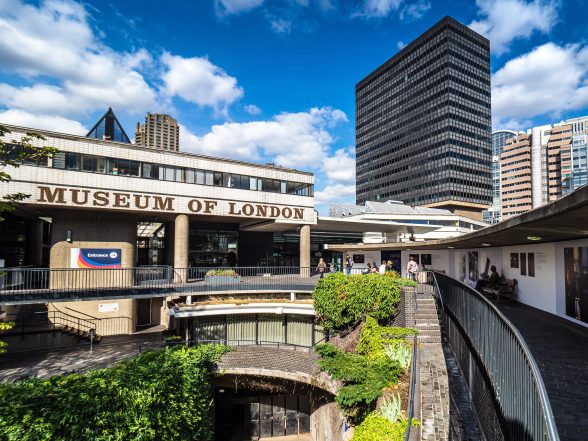
Image credit: Robert Evans
The campaign to save Bastion House and the former Museum of London building (Powell & Moya, 1977) in the City of London from demolition has won the right to present its case to the High Court.
The complex was highlighted in C20’s 2023 Risk List of the top 10 buildings most under threat in the UK, with the recent judicial review claim brought by the Barbican Quarter Organisation of residents and campaigners. The Society has long advocated for an environmentally responsible scheme that retains and retrofits the existing buildings, rather than resorting to entirely unnecessary demolition.
The Judicial Review will challenge the decision by the City of London Corporation to grant permission for the replacement of the 1970s museum building and Bastion House block with a pair of 13 and 16 storey office towers – a decision that is completely incompatible with the Corporation’s own sustainability policy, launched in December 2023 and committing to ‘promoting the reuse of existing buildings’.
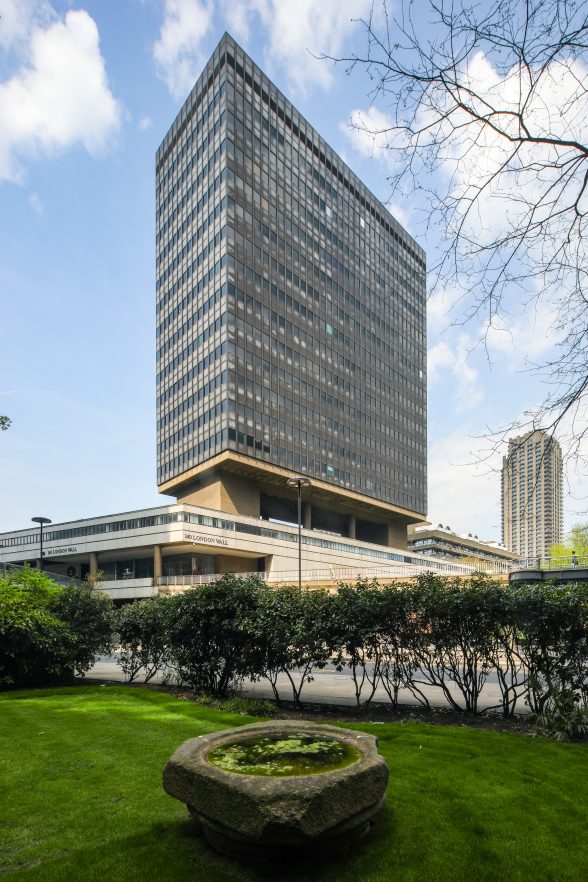
Image credit: John East
Judicial Review
Plans for the office-led development by Sheppard Robson and Diller Scofidio + Renfro were agreed by the City of London Corporation (CLC) in April 2024, with the CLC acting as both the developer and approving authority. These were then put on hold after former Communities Secretary Michael Gove intervened to issue an Article 31 order blocking planning permission. However, this order was lifted the following month by Mr Gove, and the CLC formally approved the planning application for the development in December 2024.
This decision is now set to be contested in the High Court by Barbican Quarter Organisation. The group launched its legal challenge in the weeks following the decision to approve, and has now been granted permission to bring its judicial review claim.
This questions whether the decision to approve the development followed correct procedure and complied with environmental legislation and planning policy. The group says that demolition would result in tens of thousands of tonnes of carbon dioxide being released, despite the current buildings being confirmed as safe and suitable for re-use by industry experts.
The claim is being brought on three grounds:
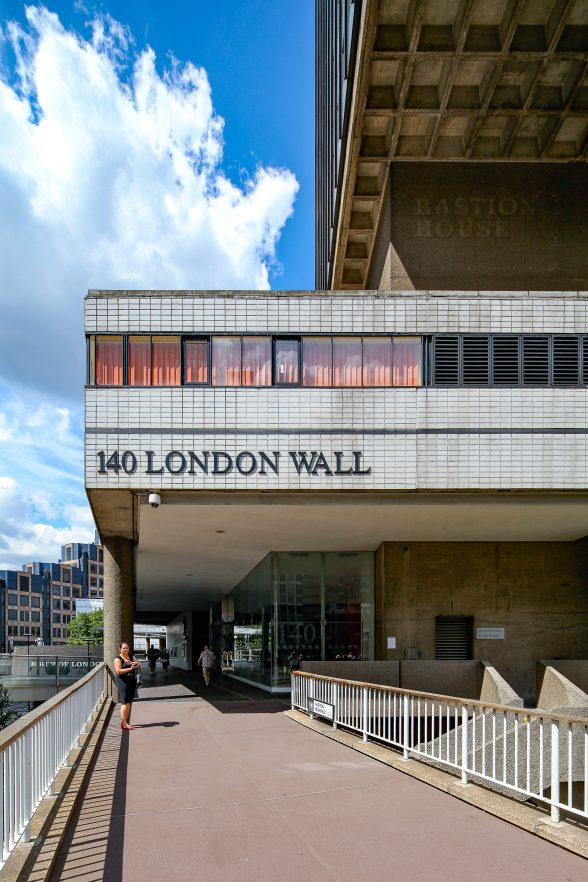
Image credit: John East
Post-war heritage of the City
The first post-war museum to be built in London and the largest urban history museum in the world, the Museum of London was designed when architects Powell & Moya were at the height of their reputation and prestige. Best known for the Skylon at the Festival of Britain they were one of the most significant practices in postwar Britain.
Housed within an angular and robust white-tiled concrete structure, the museum is skillfully placed on a considerably constrained site. Its solidity protects the interiors from the traffic noise outside and shelters a quiet courtyard garden, while a great dark brick-clad rotunda – referencing the nearby Roman city walls – rises from the centre of a busy roundabout, acting as an arrival point to the complex.
To the east is Bastion house, also by P&M, built as a speculative office development above the podium, as part of the new museum scheme. Standing on piers of biscuit-coloured concrete with Miesian bronzed curtain-walling, it is now a rare survivor of a hugely important part of the City of London’s post-war planning history. Both are now earmarked for demolition, as the museum prepares to move to a new cultural quarter in the renovated Smithfield Market and the City of London seeks to maximise the development potential on the vacated site, located on the corner of the Grade II listed Barbican Estate.
Historic England has issued a Certificate of Immunity (COI) from listing, concluding that the museum and Bastion House fall short of the very high bar that buildings need to reach to be listed, while a highly contentious report by City claims the buildings are ‘very much at the end of their design lives’ and no longer fit for purpose.
Become a C20 member today and help save our modern design heritage.