
This website uses cookies
This website uses cookies to enable it to function properly and to analyse how the website is used. Please click 'Close' to accept and continue using the website.


Techniquest, Cardiff Image credit: Steve O’Prey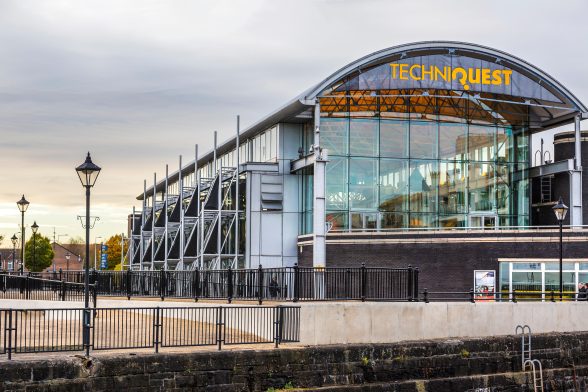
Techniquest
ABK Architects
Cardiff
1995
As the 20th century entered its adolescence, Cardiff’s docks stood at the heart of the world’s coal trade, outstripping the tonnage handled at rival docks in London and Liverpool. Mine owners and shipping agents met at the opulent Cardiff Coal Exchange in Mount Stuart Square to set the international price of coal, and it was in those halls that the world’s first £1 million business deal was reputed to have taken place. After the First World War the terms of the Treaty of Versailles triggered a flood of cheap German coal into Europe, and, further hit by the depression of the 1930s and the rise of oil as a maritime fuel, Cardiff’s docks never really managed to recover.
In the early 90s, the Cardiff Bay Development Corporation decided to turn the Inner Harbour into a vibrant waterfront area including three flagship buildings: a new opera house, a maritime heritage centre, and a national hands-on science centre for Wales.
Techniquest is a high-tech phantasmagoria of Victorian industry and mid-90s scientific charisma: a retained 19th century cast and wrought-iron boat shed frame, devoid of heavy machinery bar a solitary 25-ton transporter crane, sits mighty, and glazed, at the centre of an exhibition scheme that includes a science laboratory, a Buckminster Fuller-esque mini-planetarium (Starlab), a lecture theatre, an electronics workshop, a wet exhibit area and various administrative offices. The exhibition space occupies the full 11-metre-high volume of the old engineering works, and all the forces of nature bubble, blow and fizz across interactive contraptions that sit where workers and machines once toiled. Though sheltered by an external series of sunshades pulled tight like a fleet of drumskins, daylight streams in through a wall of glass overlooking the old graving docks to the south, and the silver, white and grey colour scheme that gives the building a metallic High-Tech pizzazz is internally contrasted with bright, often primary-coloured exhibits in a grand hall of learning fit to rival any stock exchange.
It was Paul Koralek of ABK who decided to give new life to the structure of Bailey’s Heavy Engineering Workshop, and what was already recognised as a local landmark was thus dynamically transformed into a participatory lodestar. Indeed, Techniquest is an intriguing early exploration of what we’d now term as retrofit, or adaptive reuse. In 2017, Koralek said that [when designing a building] “One is setting the stage for what people want to do, need to do, can do”, and true to this ethos, Techniquest demonstrates a building’s ability to navigate change harmoniously within a fragile and disappearing industrial culture.
Become a C20 member today and help save our modern design heritage.