
This website uses cookies
This website uses cookies to enable it to function properly and to analyse how the website is used. Please click 'Close' to accept and continue using the website.


St Brigid’s Church, Belfast Image credit: Aardvark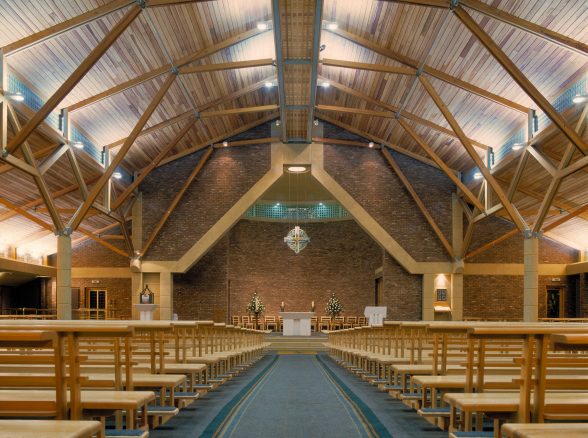
St Brigid’s Church
Belfast
Kennedy FitzGerald Architects
1995
According to the Banishment Act of 1697, all ordinaries and regular clergy of the Catholic Church were obliged to leave Ireland within a year. In defiance of this law, an intrepid friar rowed across the River Lagan to celebrate Mass with a small congregation in the shelter of a sandpit. Whilst giving the final blessing at mass he was shot dead and later buried where he lay. The liturgical use of that location, now known as Friar’s Bush, slowly passed into history and legend, and the site would eventually fall within what is now St Brigid’s Parish. Although St. Mary’s Church, built in the 1780s, is widely accepted to be the first formal Catholic church in the city, St. Brigid’s claims that the real cradle of Catholicism in Belfast lies within its parish boundaries, at the site where the friar fell.
The current iteration of the parish church, built by Kennedy FitzGerald Architects, received widespread critical recognition, including the 1996 RIAI Regional Award, 1996 RIBA Regional Award, 1996 Civic Trust Award, 1996 Craftsmanship Award, and 1996 Regional Brick Award and it is not difficult to see why.
Following a series of bombings in the Troubles and a subsequent cross-denominational funding campaign, the original 1893 church was replaced by a beautiful, 800-seat shelter that might be best described as Belfast Byzantine. The building is a sacred symphony of thoughtful details: Ken Thompson’s stations of the cross are cut in Kilkenny limestone, the polished brass and green patinated copper tabernacle, candlesticks and candlestand adopt forms that reflect the internal structures of the church and, at the right time of day, the French limestone altar, carved by Dublin sculptor Tom Glendon, is kaleidoscopically painted in the light of Lua Breen’s stained-glass windows. The use of red brick intentionally evokes the city’s Victorian terraces and a series of brick drums, akin to terracotta pots, tumble out of the central body, each gilded with a glass brick clerestory and held together by a unifying canopy – itself decorated and sliced in two by a similar band of glimmering glazed jewels. The layout is largely traditional, but the spiritual and secular spaces are separated by a series of changing levels and volumes.
The Nave of a church is symbolically and etymologically linked to an upturned boat; ‘navis’ is Latin for ship, and the church, like Noah’s Ark, the apostles’ fishing boats, and the friar’s rowboat, is considered a vessel that carries the parish through the tumultuous currents of life. Indeed, against the dimming light St. Brigid’s silhouette mimics a large steamboat on water, its lights celestial, and warm.
Become a C20 member today and help save our modern design heritage.