
This website uses cookies
This website uses cookies to enable it to function properly and to analyse how the website is used. Please click 'Close' to accept and continue using the website.


Trinity Footbridge, Salford Image credit: Arcaid Images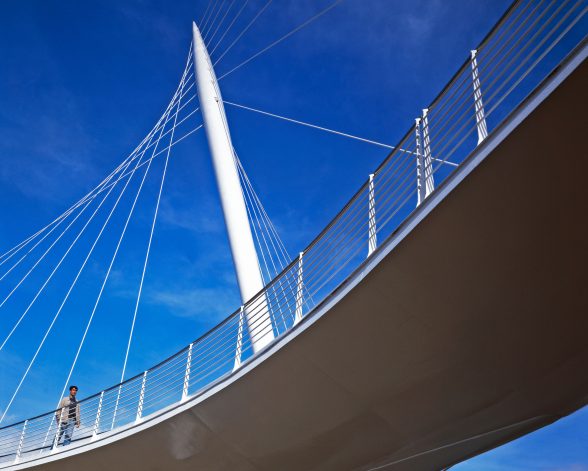
Trinity Footbridge
Manchester
Calatrava
1995
Trinity Footbridge
It was bridges that first carried Santiago Calatrava to global prominence, and he has since gone on to design every imaginable civic form: museums, universities, stations and airports, each of them prodigious and haunting. Yet there is only one Calatrava bridge in the United Kingdom, and it crosses the River Irwell, connecting Manchester with Salford.
Trinity Footbridge more than earns its place within Calatrava’s formidable portfolio. It’s 41-meter pylon, angled at 60 degrees, leans into the wind like a sail or snapped instrument, punctured by taut cables anchored into its surface with pinpoint structural accuracy. A conventional cable arrangement along the main span is set in deliberate contrast to two hyperbolic crossed fans, their asymmetry producing a tense, choreographed display of engineering artistry.
Santiago Calatrava’s buildings and structures are frequently described as mimicking fossils and organic forms, and his is an architecture that at times appears to be in an interrupted state of ossification. Trinity Footbridge continues this lineage. It is a structure of force and mass that nevertheless conveys an unmistakable sense of movement, as though it were bracing itself to stride across the water.
Taking its name from nearby Trinity Church and springing from the Salford bank, the footbridge was conceived as both a gesture of connection and an emblem of regeneration. It provided the first dedicated pedestrian crossing of the Irwell and became an early catalyst in the redevelopment of Chapel Wharf, a landscape of former docklands edging towards transformation. Calatrava himself has spoken of the temporal dimension of architecture, remarking to his biographer that “architecture itself moves… [and] with a little chance, becomes a magnificent ruin.” That idea, of the inevitable drift of time, is quietly embedded in the bridge’s allure. It should be a source of national pride that one of the world’s foremost bridge designers chose to bestow on the North West a work of such clarity and confidence.
Become a C20 member today and help save our modern design heritage.