
This website uses cookies
This website uses cookies to enable it to function properly and to analyse how the website is used. Please click 'Close' to accept and continue using the website.


BAPS Shri Swaminarayan Mandir, Neasden Image credit: Historic England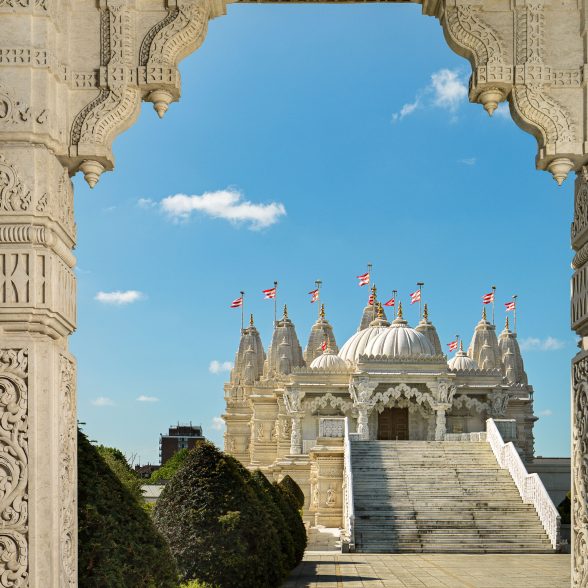
BAPS Shri Swaminarayan Mandir (Neasden Temple)
Chandrakant Sompura
Neasden, London
1995
BAPS Shri Swaminarayan Mandir, commonly known as Neasden Temple, was the first traditional Hindu temple built in Europe and for many years, the largest built anywhere outside of India.
Underlying every traditional Hindu mandir is an ancient, exact and religious ‘Discipline of Sacred Architecture’ called Vastu Shastra, a large body of literature that devotedly combines art, astrology, geology, structural engineering, sculpture, mathematics, ethics and spiritual discipline. Thus, a stone’s throw from the North Circular, just south of IKEA and the looming Wembley Arch lies a spiritually charged building designed to integrate the dweller, the dwelling and the cosmos with meticulous detail: an ingot of holy perfection landed in North West London.
Mandirs are built to last thousands of years, so no metal can be used for their structural reinforcement or support; this building is operating on a timescale far beyond the lifespan of steel, and ferrous metals are believed to concentrate the earth’s magnetic field and thereby impede meditation and devotion. Accordingly, all 3,000 tonnes of Bulgarian limestone, 1,200 tonnes of Italian Carrara marble, and 900 tonnes of Indian Ambaji marble hand-carved in India and contained in Neasden Temple are self-load bearing. In order for such balance to exist, the more than 1,500 stonemasons, volunteers and builders of the Mandir had to be, among other things, attuned to the stone and their tools, righteous, cheerful, and free from malice, egotism, greed and jealousy. When the first foundations are dug a small urn is placed directly below where the Garbh-Gruh (womb) and Shikhars (spires) will rise: a germinating seed from which a forest of intricacy climbs upwards from the earth like mineral rich stalagmites. Rightly, this is a structure that relies on harmony, and the white stone hums in the Brent sun like a large moon rock fallen from heaven.
Adjacent to the stone mandir is the exquisitely carved wooden Haveli, built of Burmese teak and English oak. Prior to the construction of Neasden Temple, a Haveli had not been constructed anywhere for over a century, and the unique vernacular design rooted in the 16th century, akin to a domestic rather than monumental architecture, was beginning to die out. Neasden Temple had a global impact on the revitalisation of Haveli construction and Havelis have since been erected at mandirs in Nairobi, Chicago, Los Angeles, Toronto and across India.
Winner of the Inaugural National Pride of Place award in 2007, the temple was voted as the greatest source of pride amongst local Brent residents. Unlike almost anything else built in our lifetimes, this is an important national monument and a vital part of Britain’s increasingly multicultural story in the latter part of the 20th century.

Become a C20 member today and help save our modern design heritage.