This website uses cookies
This website uses cookies to enable it to function properly and to analyse how the website is used. Please click 'Close' to accept and continue using the website.


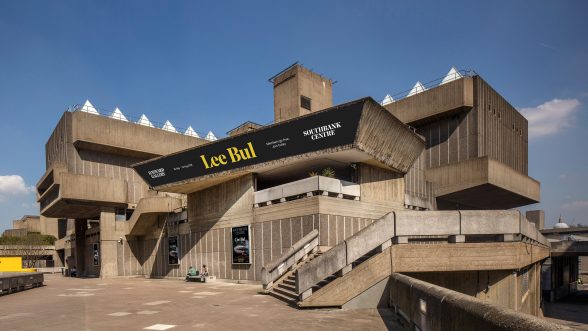
Image © Morley von Sternberg
We’re thrilled to announce that the 1960s Southbank Centre, which includes the Hayward Gallery, Purcell Room, Queen Elizabeth Hall and skatepark under-croft, has finally been Grade II listed (List Entry Number:1492622) by DCMS – the government Department for Culture Media and Sport.
The visionary combination of performance spaces and art gallery is a post-war architectural masterpiece, yet is perhaps the most totemic – and controversial – example of British Brutalism. Twentieth Century Society and Historic England (formerly English Heritage) have recommended listing the Southbank Centre on 6 separate occasions since 1991, yet this advice had been consistently rejected by the Secretary of State of the day, until now. The decision brings to an end an unprecedented 35 year-long impasse, one of the longest running battles in British architectural heritage.
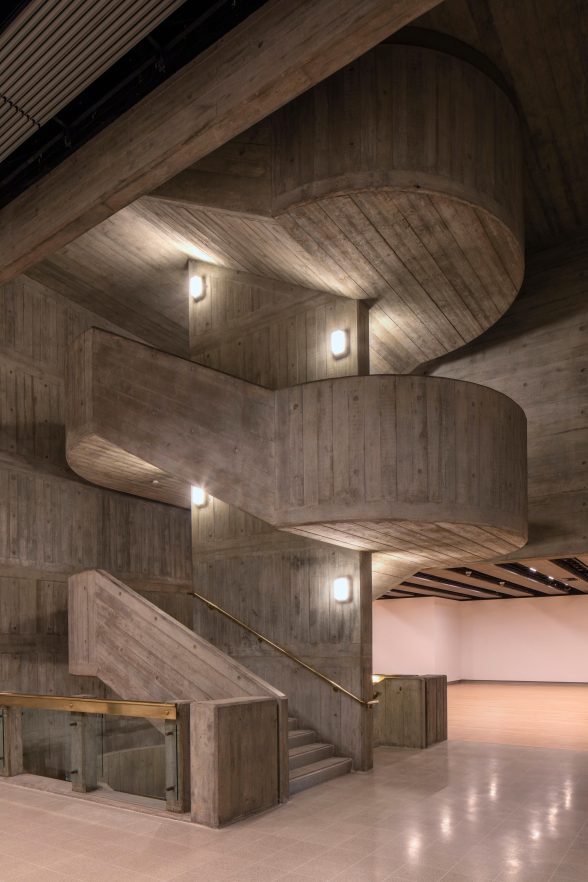
Image © Morley von Sternberg
‘Britain’s ugliest building’
The Hayward Gallery, Purcell Room and Queen Elizabeth Hall were designed by the Architects’ Department of the London County Council (later the Greater London Council) and were opened by Her Majesty the Queen in 1967 and 1968 respectively. Under the leadership of architect Norman Engleback, the young design team included John Attenborough, Warren Chalk, Ron Herron, John Roberts, WJ Sutherland, Dennis Crompton and J W Szymaniak (Herron, Chalk and Crompton went on, as part of the Archigram group. These were adventurous architectural compositions, with board-marked concrete surfaces inside and out, connected to walkways, staircases, rooftop terraces, and with sculptural concrete air conditioning ducts and pyramidal glazing. This was in deliberate contrast to the smooth, Scandinavian-style Modernism of the neighbouring Royal Festival Hall, and quickly attracted controversy, being voted ‘Britain’s ugliest building’ by readers of the Daily Mail in October 1967.
The abolition of the Greater London Council in 1986 led to the creation of the South Bank Board, which sought to generate more income from the site. The then unpopular 1960s buildings presented an attractive target for redevelopment and new revenue-earning spaces, with the subsequent four decades bringing numerous damaging demolition plans and proposals for the complex.
A scheme by Terry Farrell was launched in 1989, which would have wrapped the buildings in a postmodern shell, yet this was abandoned in 1993. ‘The Wave’, a £70 million Richard Rogers plan in 1994 proposed a glass roof cloaking the buildings and semi-enclosing the outdoor spaces. Criticised for a lack of practicality and high cost, this was also axed after it failed to receive National Lottery funding. A masterplan for the entirety of the South Bank by Rick Mather in 1999 promised Mather’s trademark rational, cool, modern approach as ‘the perfect antidote to the centre’s drab squalor’ (Edwin Heathcote), but again remained unexecuted.
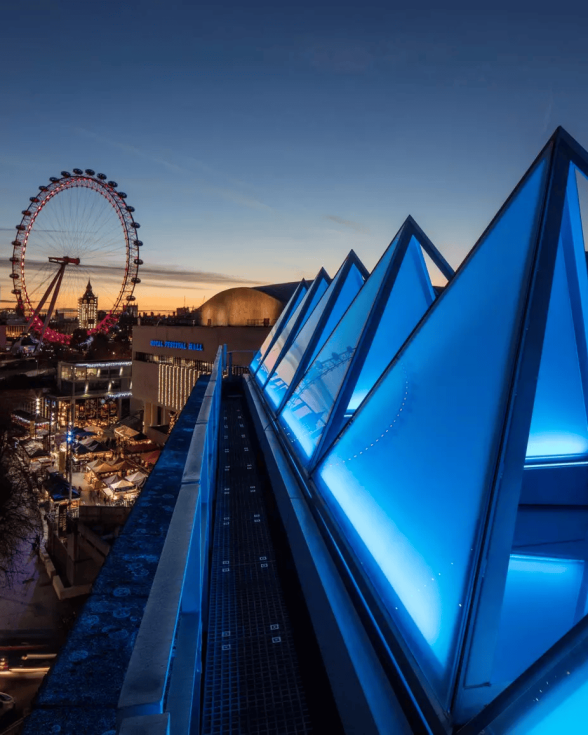
Image © Morley von Sternberg
In 2012, C20 Society nominated the Southbank Centre for the World Monument Fund ‘Watch List’ of endangered heritage sites worldwide. In 2013, architects Feilden Clegg Bradley launched a £120 million vision for the ‘Festival Wing’, including a 60-metre-long glazed pavilion looming over the Hayward Gallery, and 5,000 sq metres of commercial space in containers. Vigorously opposed by C20 Society, this plan was dropped in 2014 thanks largely to the protests of skateboarders in the under-croft space of the QEH, whose ‘Long Live the Southbank’ campaign attracted over 80,000 supporters and the backing of the Mayor of London.
The same architects (FCBS) went on to lead an exemplary programme of restoration and conservation on the Hayward Gallery, Queen Elizabeth Hall and Purcell Room in 2018, following a £16.7 million grant from Arts Council England.
What is Brutalism?
The term Brutalism is derived from the French ‘betón brut’, meaning ‘raw concrete’, and refers to a style of late modernist architecture that emerged during the second half of the twentieth century. Brutalist architecture, characterized by bold geometries, the exposure of structural materials, and functional spatial design, was an expression of social progressivism and became a favoured style for public architecture of the time. While most readily associated with the use of concrete, many brutalist buildings are constructed from brick, timber and glass, with a ‘reverence for materials’ (Peter and Alison Smithson) being the guiding principle.
Often beset by poor maintenance and unfairly associated with anti-social behaviour, brutalist buildings fell out of fashion by the late 1970s and increasingly came under threat of demolition. Major losses included Birmingham Central Library and the Tricorn Centre, Portsmouth. The listing of high-profile examples like Trellick Tower in Kensington, Preston Bus Station, and Park Hill in Sheffield in the 1990s and 00s began a process of wider critical and public reassessment, which continues to this day.
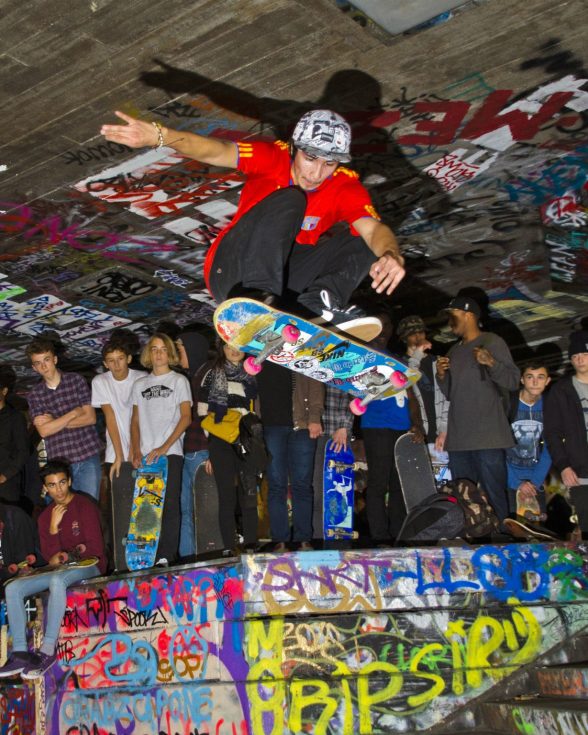
Image © Long Live the Southbank
Catherine Croft, Director of Twentieth Century Society said:
The battle has been won and Brutalism has finally come of age. This is a victory over those who derided so called “concrete monstrosities” and shows a mature recognition of a style where Britain led the way.
We’re absolutely thrilled that this internationally recognised concrete-masterpiece of post-war architecture has finally been accepted as part of our national heritage, some 35 years after the Twentieth Century Society first campaigned for the Southbank Centre to be protected.
The lack of listing had become a complete anomaly; it is admired as one of the best Brutalist buildings in the world, so this decision is obviously very well deserved and long overdue. The arts complex is a highly sophisticated, sculptural masterpiece, with enormous richness of form and detail inside and out. The experience it gives concert goers and gallery visitors is unlike any other venue in the country, its virtuoso spaces still unrivaled.
Credit must go to the Heritage Minister, Baroness Twycross, who has done the right thing, where her predecessors over the past few decades have failed to act, and to Historic England who along with the Twentieth Century Society, have consistently made the case for its place on the national register.
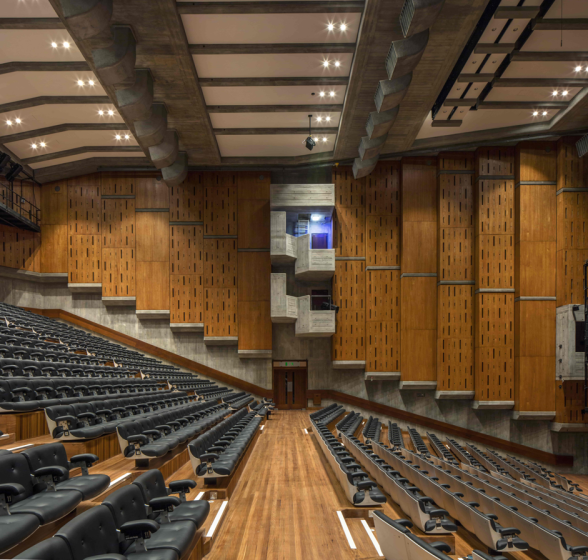
Image © Morley von Sternberg
Modern heritage of the South Bank
The unique modern heritage of London’s South Bank is composed of a series of outstanding post-war buildings, bridges and public artworks that stretch along the most prominent bend in the River Thames, making the omission up to now of the SBC all the more extraordinary.
The South Bank entries on the national register are:
Become a C20 member today and help save our modern design heritage.