This website uses cookies
This website uses cookies to enable it to function properly and to analyse how the website is used. Please click 'Close' to accept and continue using the website.


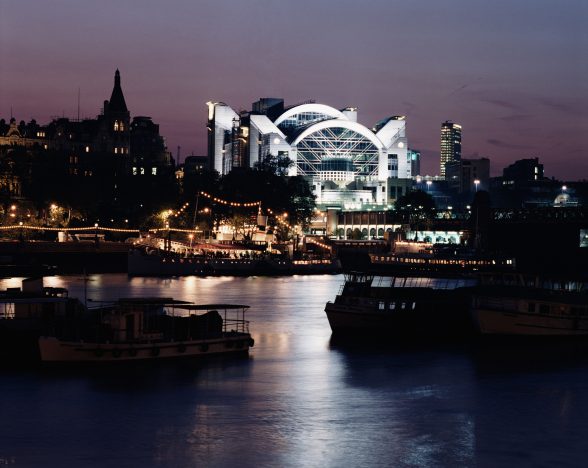
Image credit: Carolyn Clarke
C20 Society has recommended Grade II* listing for Sir Terry Farrell’s Embankment Place (1987-90) in a consultation with Historic England, following a COI (Certificate of Immunity from listing) application from the building owner. Conceived as a ‘Palace on the River’, Embankment Place was Farrell’s breakthrough project and the most important of his three large-scale London commissions of the late 1980s and early 90s – Alban Gate in the City of London and the SIS Building at Vauxhall Cross being the other two.
Occupying a key position on a sharp bend in the Thames, Embankment Place sits confidently in a family of landmark riverside buildings that span the Palace of Westminster (1840-76) to Somerset House (1776-1856); including Whitehall Court (1884-87), The Savoy (1886-89), Shell Mex House (1932), and the Ministry of Defence (1939-59). A ‘groundscraper’ development atop Charing Cross Station, it was the most prominent in a wave of air rights developments of the period that conjured office space over London rail termini. Early discussions with planners led to a tiered profile stepping down to the river, as at Vauxhall Cross. Structural engineers Ove Arup and Partners suggested slinging the office floors from bowstring arches, with their transfer structure minimising the number of columns penetrating the platform and brick vaults below. The resulting building found architectural expression in a barrel roof, a stylised nod to original Victorian station roof and the ‘egg in a box’ form of the Royal Festival Hall across the river.
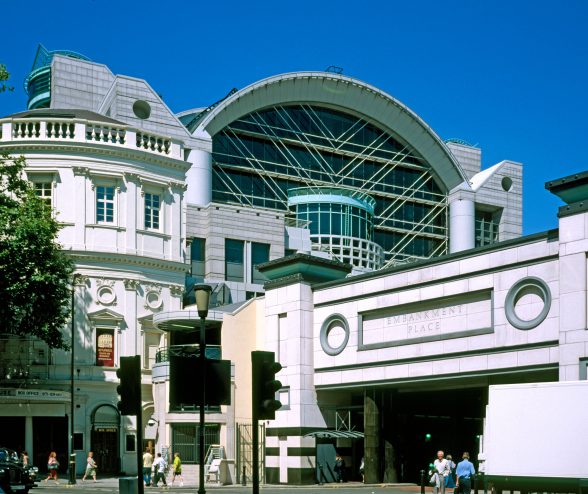
Image credit: Andrew Holt
Charing Cross
The original vaulted roof of the Victorian train shed at Charing Cross (1863-65) collapsed on Dec 5 1905 while undergoing repairs, and was replaced by a nondescript flat roof. The old arched trainshed roof had a monumental quality on the river, compared favourably by historian Marcus Binney to the Grand Palais on the Seine in Paris, another noble glass and steel construction of the 19th century. Yet by the mid-1980s the streets surrounding the station, specifically Villiers Street and Embankment Place, were run down and inhospitable for the high level of pedestrian traffic circulating between the station, Embankment underground station and Hungerford Bridge.
Developers Greycoat brought Terry Farrell Partnership on board to develop a proposal for the new building alongside a package of public realm improvements, beneficial in the eyes of both British Rail and Westminster City planners, and enhancing the appeal to the right sort of corporate tenant. The challenge was to create a front door for both the station and the office building on the Strand, a front door on the River, and an entrance on the the drab Villiers Street side. The Chief Executive of Greycoat was quoted as saying: ‘We were looking for a building of exceptional character on a very important site. We wanted a building of drama. A proscenium arch.’
Embankment Place made use of Charing Cross Station’s air rights and suspended nine-storeys of offices above the railway tracks, isolating the space from railway vibration. The resulting bowstring arch over the tracks was supported on 18 columns which rise through the tracks and platforms.
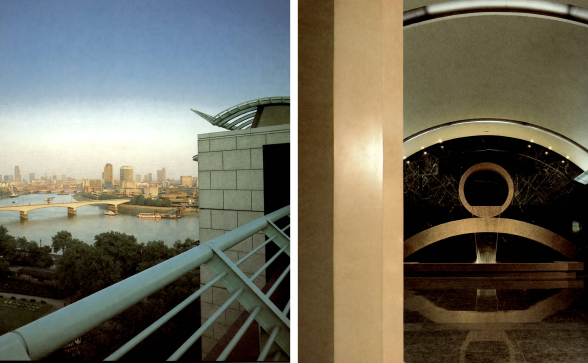
Image credit: Alan Williams
Postmodern ‘Palace on the River’
Farrell was one of the first architects to design in a Postmodern style in the City, with the Allied Irish Bank in Queen Street (1982-85) and Midland Bank on the corner of Fenchurch and Leadenhall streets (1983-86), and was a leading architect/planner of the short-lived boom in large-scale office buildings which followed the ‘big bang’ banking deregulation. This continued on a monumental scale with his trio of ‘Grand Projets’ in the Capital, of which Embankment Place is the most contextual and ultimately the most successful.
The main block is primarily stone-clad in a pale grey Sardinian granite, harmonising well with the Portland stone of the buildings either side and across the river. The four main core towers are topped with weathered copper fins, nicknamed ‘Terry Farrell’s eyebrows’ by the developer, and slope down at an acute angle to meet the roof. The glazed ends are covered with a powerful chevron motif and the river facing facade has a segmented bay in the middle, looking somewhat like the bridge of a ship.
The Villiers Street block is variously clad in grey and black polished granite, red brick and steel panels, with large segmented portals that nod to Giuseppe Vaccaro’s Palazzo delle Poste in Napoli (1928-1936). It reads as a sequence of separate buildings, responding loosely in height to its C19 neighbours opposite, however behind the frontage is a complex series of semi-open interlinked public and private spaces serving the air rights building, the station and the wider public realm.
The short road, also known as Embankment Place, that connects Villiers Street with Northumberland Avenue, is framed by entrance portals to the east and west with piers of bold black and white stone banding, stylised verdigris pier capitals and a deep, panelled stone frieze.
The project won the 1991 RIBA National Award, the 1991 RTPI Award for Planning Achievement, the 1991 Civic Trust Awards and the 1994 BCO Award among others.
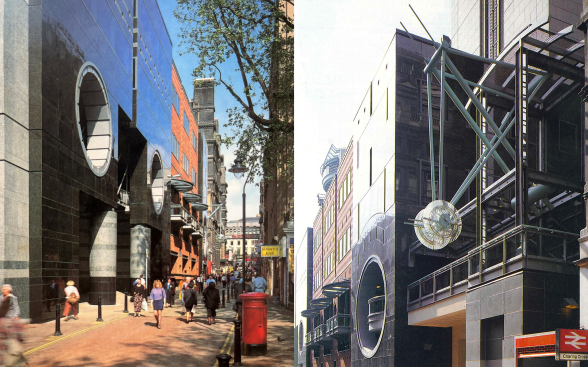
Image credit: Dennis Gilbert
Sir Terry Farrell (1938-2025)
by Owen Hopkins, Director of the Farrell Centre.
If there is one thing to connect the multiple threads that shaped Sir Terry Farrell’s career, it’s the idea that cities are above all collective endeavours and a profound belief in placing communities at the heart of the planning process. Although a fierce advocate for the architecture and planning professions, winning the Royal Town Planning Institute’s Gold Medal in 2017 (but scandalously never the RIBA Royal Gold Medal) Farrell argued passionately for the public to have a voice in shaping the city around them. This sometimes put him at odds with the received wisdom of the professions, particularly regarding questions of heritage, but more often than not he was proved right.
His project for Covent Garden’s Comyn Ching Triangle was a piece of urban repair; conceived a few short years after the abandonment of the plan to replace the piazza and surrounding streets with an urban motorway and modernist megastructure. The dilapidated Georgian buildings were sensitively restored, while Farrell designed buildings in the corners, self-consciously new but sensitive to their surroundings. In the courtyard, conservation was complemented with wonderfully bravura blue mannerist doorcases. Farrell would adopt similar approaches even when building at scale: at Embankment Place where he sought to rejuvenate Villiers Street, and at Alban Gate, a building with a wonderfully rich relationship to the surrounding city.
He became involved in the Mansion House Square saga, developing, with SAVE Britain’s Heritage, an alternative to the proposed demolition of the Mappin and Webb building, balancing careful restoration with clever additions. The scheme, described by Farrell as ‘conservation plus’, was presented at the public enquiry, justified not just on heritage grounds but on economic and social ones too: the idea that retaining the small shopfronts would contribute more to the life of the city than a single large building.
By the 1990s and 2000s, Farrell was a global star, gaining a slew of major commissions in the Far East. But it was arguably in his native Newcastle where he completed perhaps his greatest project in reimagining the derelict quayside into a vibrant mixed-use urban quarter, with offices, leisure and residential. This was urban repair at city scale, a project whose greatest success is that most people who use it every day assume it was always thus.
Farrell was very happy to see a number of his works listed, but disappointed with the loss of TV-am, the mutilation of 76 Fenchurch Street and impending plans to significantly alter Alban Gate. As more of his projects reach the 30-year threshold for listing, I’ve no doubt Terry would have been pleased to see them join the list while remaining mindful, as always, that heritage is not fixed but a living entity that should actively contribute to the culture and character of the city.
This biography is an extract from an obituary, set to be published in the forthcoming 2026-1 issue of C20 Magazine.
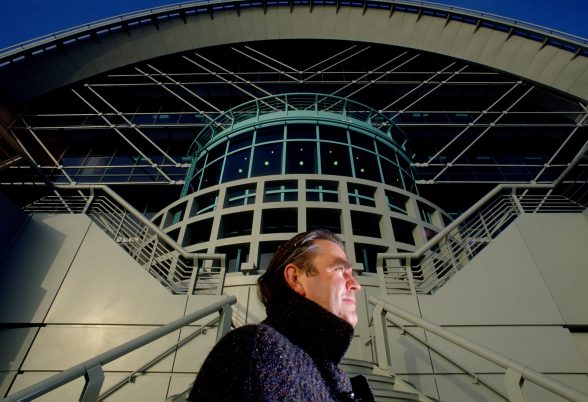
Image credit: Phillip Sayer
📍 Blackwall Tunnel Vent Shafts, 1967 – Grade II (LCC Architects’ Dept)
📍 125 Park Road, Westminster, 1968-70 – Grade II (Farrell/Grimshaw Partnership)
📍 The Herman Miller Factory, Bath, 1976-77 – Grade II (Farrell/Grimshaw Partnership)
📍Comyn Ching Triangle, Camden, 1983-85 – Grade II
📍 Henley Royal Regatta HQ, Oxfordshire,1986 – Grade II
📍 Cosmic House, Kensington & Chelsea,1979-85 – Grade I
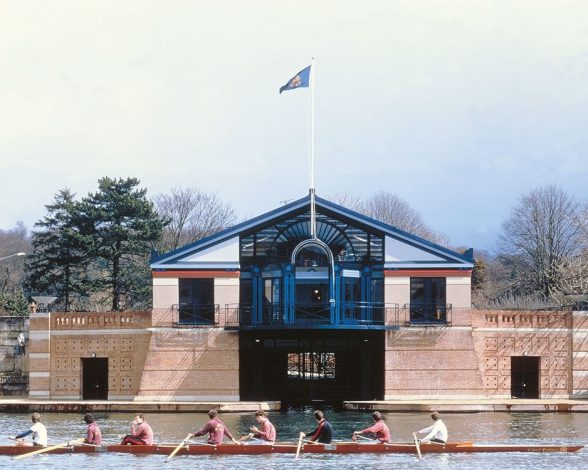
Image credit: Farrells
Become a C20 member today and help save our modern design heritage.