This website uses cookies
This website uses cookies to enable it to function properly and to analyse how the website is used. Please click 'Close' to accept and continue using the website.


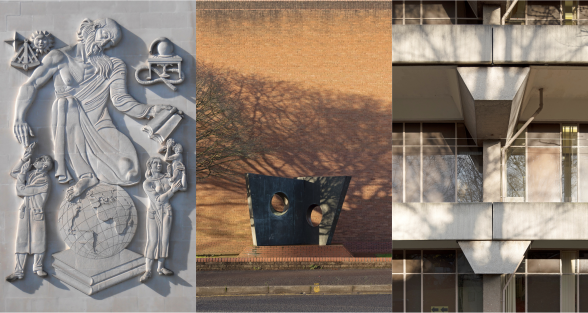
Image credit: Jonathan Vining
Three outstanding post-war buildings at the University of Cardiff have been Grade II listed by Cadw, following support from C20 Cymru and C20 Society.
The principals reasons for their designation are as follows:
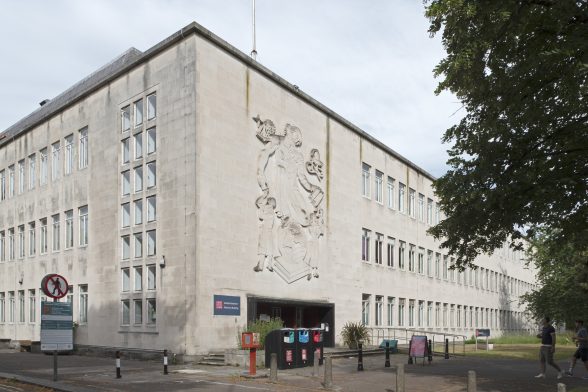
Image credit: Jonathan Vining
Redwood Building, 1958-61
The Redwood Building is a characteristic late work of Sir Percy Thomas, the acclaimed founder of Wales’ largest architectural practice of the twentieth century, representative of his post-war embrace of Modernism which would be taken forward by Dale Owen and others in the Percy Thomas Partnership until the millennium. The large relief sculpture the main entrance is a fine example of the work of Edward Bainbridge Copnall. As Wales’ only College of Advanced Technology the building illustrates efforts to expand scientific education in the early Cold War. It was also an early example of the creation of new national institutions fuelling Cardiff’s growing status as a fledgling capital city for Wales. These are important aspects of Wales’ social and economic history.
It was officially opening on 2 June 1961 by the Duke of Edinburgh, who said:
‘Its exterior design is clearly influenced by the modern tendency towards greater architectural simplicity. At the same time, however, traditional materials have been used and the careful proportioning of voids and solids, together with facings of Portland stone, should enable it to take its proper place in the world-famous sequence of public-buildings in Cathays Park.
The goal of the post-war Colleges of Advanced Technology was to stop Britian falling behind the advancing technology of the USA and the USSR. A white paper in 1956 lead to the creation of ten Colleges, with nine in England’s industrial centres and one in Wales’ recently created capital city. They would be an alternative to the sixteen universities in the UK with equivalent standards of teaching dedicated solely to higher level science and technology and linked closely to the needs of industry.
The Welsh College of Advanced Technology departments of pharmacy, chemistry, biology and navigation would move to a new building while other subjects including architecture, physics and engineering remained at the older college building. The site at the northwest corner of Cathays Park had been used for allotments and a small office building of the Welsh Insurance Commission, which was demolished. Sir Percy Thomas (1883-1969) designed this first post-war addition to the civic centre, the first new building in Cathays Park since the Temple of Peace and Health, also by Thomas, which stands between the Bute building and the College of Advanced Technology.
Sir Percy Thomas said of these three buildings ‘I think they show fairly well the development of my ideas from the neo-grec of the original college, through the simplified classicism of the Temple of Peace, to the more modern treatment of … the College of Advanced Technology.’ It was amongst the last projects he was directly involved with before illness forced him to retire.
School of Music, 1970-71
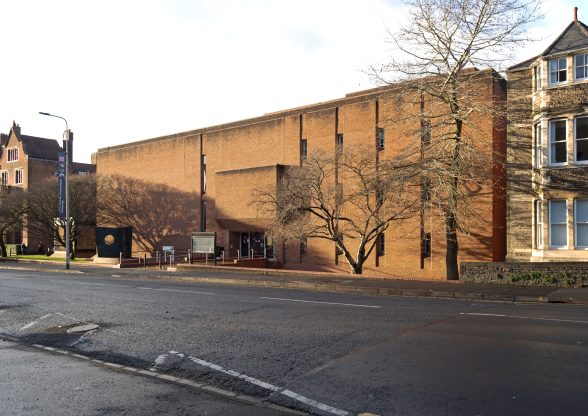
The School of Music is amongst the best works of Sir Alex Gordon; austere, finely detailed and uncompromisingly Modernist despite contextual brick cladding, described as ‘austerely handsome without, handsomely functional within’. Thoughtfully planned in collaboration with Alan Hoddinott, the internal organisation has stood the test of time and is expressed in the stark exterior. The building illustrates a key aspect of Wales’ cultural history as an important engine for the musical achievements of the post-war period, while its planning expresses the long-held aspiration towards widening access to music through the University. The large bronze forecourt sculpture is ‘Three Obliques (Walk In)’ by Barbara Hepworth, 1968 (Grade II).
Music was amongst the first subjects offered by the University College of South Wales formed in Cardiff in 1883. The School of Music was the first of a sequence of brick clad buildings by Alex Gordon and partners for the University in the early 1970s, continuing with the Sherman Theatre in 1971, the Mathematics block in 1972 and the Student’s Union in 1973, all on Senghennydd Road. Sir Alex Gordon became President of the Royal Institute of British Architects in 1971 where he was an early champion of sustainable design under the motto ‘long life / loose fit / low energy’ and also designed the large extension to the Cathays Park Welsh Government Offices completed in 1979.
The three storey, concrete framed, flat-roofed Modernist ‘shoe-box’ cuboid was clad in red brick to match the neighbouring Aberdare Hall (1895); the blind and unornamented face to the left side contains a concert hall, the with minimal vertical slit steel framed windows on right side containing teaching rooms, seperated by a projecting central canopy of brick.
Arts and Social Sciences Library, 1973-75
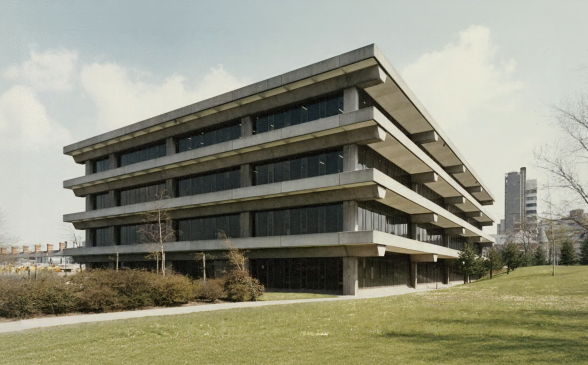
The Arts and Social Sciences Library is a key example of a twentieth century university library in Wales, designed by Harry Faulkner-Brown an influential figure in library design demonstrating his ‘ten commandments’ with clarity and finesse in its Brutalist design. These principles were that a library should be: 1. Flexible. 2. Compact. 3. Accessible. 4.Extendible. 5. Varied. 6. Organised. 7. Comfortable. 8. Constant in environment. 9. Secure. 10. Economic.
The Library represents the last major building of the post-war expansion in tertiary education in Cardiff, commenced before the economic shocks of the 1970s, and is a nationally important university library.
Faulkner-Brown’s Cardiff library was intended to be only the first phase of a library that would have been almost double the size if it had been completed. The entrance into the left-most of the four bays in the front facing Corbett Road was to have been centrally placed in a square plan building of seven bays. This would have brought the building out to the east side of Colum Road and required the purchase and demolition of the southern third of the late Victorian terrace of houses. The resulting building would have been a square in plan facing the Cathays Park government offices (CP2), then under construction in a comparable aesthetic.
At the time the Centreplan 70 proposals for redevelopment of Cardiff city centre envisaged the demolition of hundreds of Victorian buildings to make way for half a dozen tower blocks on the scale of Pearl Assurance House on Greyfriars road. Construction of Phase 1 of the Arts and Social Sciences Library was ongoing in 1973 when the global oil crisis and UK stock market crash forced a change of plans, both in the University and in Cardiff at large. The resulting building is more asymmetrical in its planning than some of Faulkner-Brown’s other libraries.
In 1976 the building won Commendations from the Royal Institute of British Architects and the Concrete Society.
Become a C20 member today and help save our modern design heritage.