This website uses cookies
This website uses cookies to enable it to function properly and to analyse how the website is used. Please click 'Close' to accept and continue using the website.


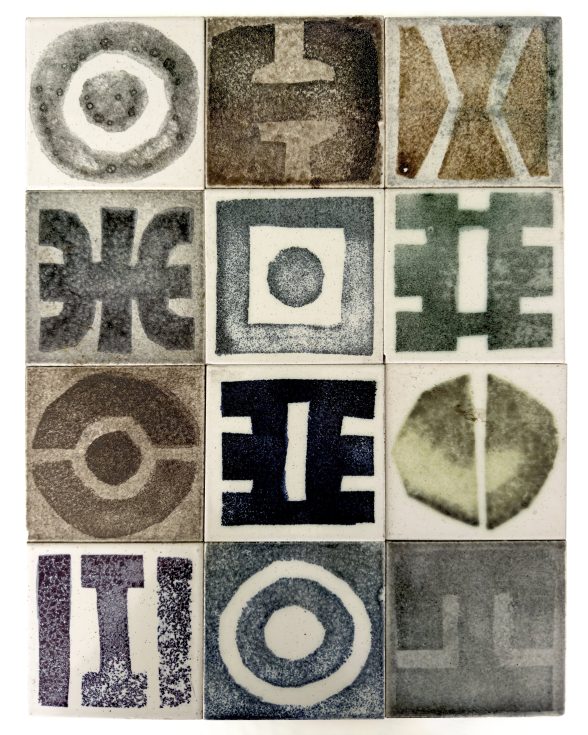
Image credit: Esther Johnson
Next year marks a decade since we first launched Ships in the Sky – a social history arts project tracing the many lives of Hull’s former Co-operative Society building, alongside the bold artworks created for it by muralist and sculptor Alan Boyson (1930–2018). Bringing together 400-plus items of archival material and memorabilia, the project explores how art, architecture and everyday life intersected in a city shaped by post-war reconstruction. Among these objects, one of my personal favourites is a sponge-print tile decorated by Boyson himself and gifted to me by his son, Matthew, in thanks for our support and enthusiasm for his father’s work.
It was originally designed for the mural installed in the bar of the Skyline ballroom, a glamorous nightspot on the fourth floor of the Co-op building on Jameson Street. Boasting a unique ‘handkerchief ’ concrete dome roof, it opened in 1962 and played host to a galaxy of stars including Pink Floyd, Jimi Hendrix, Humphrey Lyttleton and The Kinks.
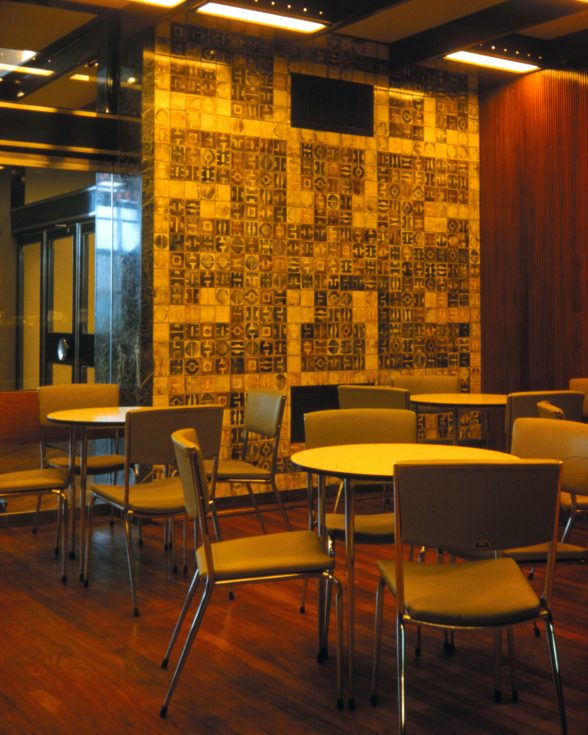
Image credit: Ships in the Sky Collection
Using sponges, Boyson printed twelve bold geometric forms on to 100 × 100mm blank Hereford tiles. The result was a vibrant, rhythmic wall piece that captured the modernist spirit of the new store and venue. The Skyline was then a lively social hub, reflecting Hull’s determination to look forward after the devastation of WWII – having been the second most bombed city in Britain outside London, with 95 per cent of its housing damaged during 82 air raids. The mural was one of three Boyson artworks commissioned by the building’s architect, E. P. ‘Philip’ Andrew (1930–2021). The others were the monumental 20m x 20m Three Ships mosaic, now Grade II listed and still visible on the façade; and the Shoal of Fish mural, also located on the fourth floor.
As the store evolved and later became a BHS, successive refurbishments radically altered the interior. The ballroom was enclosed, and the Skyline mural concealed. Over time, more than half of its tiles were damaged or lost, and the artwork was believed to have vanished entirely. That assumption was challenged in 2018 during a Ships in the Sky interview with Philip Andrew, conducted by me, Boyson expert Christopher Marsden, and Hull Heritage Action Group member and Ships researcher Leigh Bird. Consultation of the original architectural drawings confirmed the mural’s location, allowing its remains to be partially uncovered.
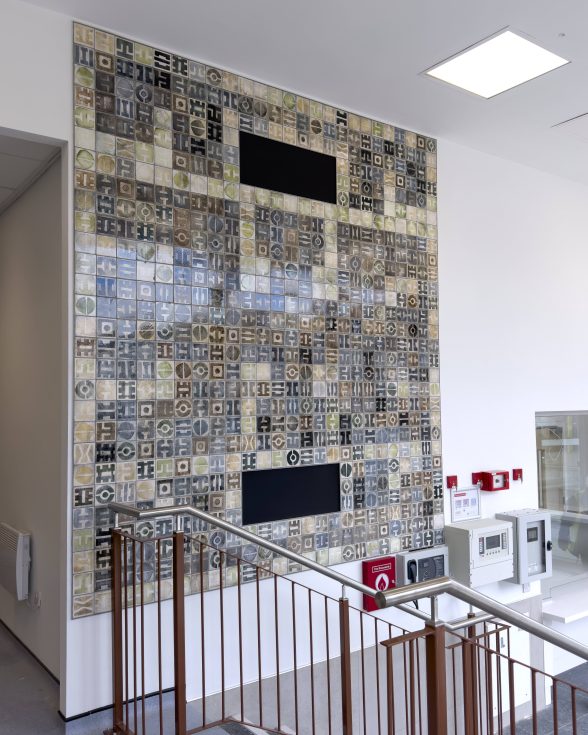
Image credit: Esther Johnson
Its rediscovery presented both a challenge and an opportunity. As the last known example of Boyson’s sponge-print technique, Hull City Council commissioned Heritage Project Contracts to carefully remove each surviving tile. Of the original 658, 396 were missing and required replacement. Specialist makers at Craven Dunnill (Jackfield) Ltd recreated the lost tiles by hand, carrying out extensive colour trials
and sponge-print testing to ensure fidelity to Boyson’s original vision.
In 2025, the restored mural was reinstalled at the new NHS Community Diagnostic Centre on Albion Street, Hull. Permanently on public display, it can be experienced up close inside the building, or viewed day and night through the large streetfacing windows.
My own tile, along with other discoveries, now features in The Marvel from Marple, the first exhibition dedicated to celebrating Boyson’s work. Supported by the Henry Moore Foundation and Stockport borough council, it is hosted by Stockport’s new cultural centre, Stockroom – fittingly housed in a 1960s retail precinct also designed by Philip Andrew, and overlooked by Boyson’s iconic concrete carpark screens.
The Marvel from Marple is at Stockroom, Hull, from 19 June to 30 September (see stockrm.org). For more on the mural and Ships in the Sky project visit shipsinthesky.co.uk/ skyline-sponge-print
Become a C20 member today and help save our modern design heritage.
Comments