This website uses cookies
This website uses cookies to enable it to function properly and to analyse how the website is used. Please click 'Close' to accept and continue using the website.


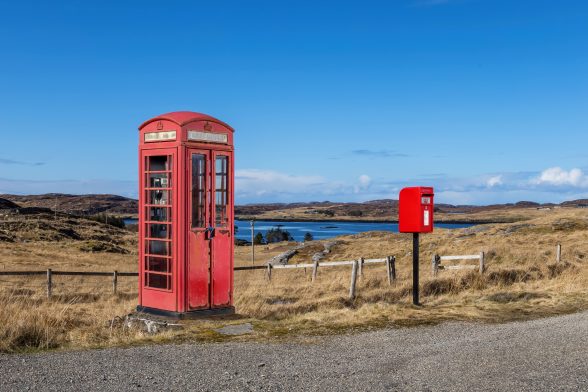
Image credit: John Maher
Twentieth Century Society has revived its famous telephone boxes campaign, to mark 40 years since the very first telephone kiosk in the country was listed, on 6th August 1986.
First introduced a century ago in 1926, these beloved yet now largely obsolete items of street furniture remain an internationally recognised symbol of British design excellence and a reassuring reminder of the way we used to live. The Society’s landmark battle to save classic kiosks is arguably the most successful heritage campaign in history, with more than 3,000 examples and counting now protected on the National Register of Historic Buildings.
After scouring the length and breadth of the country, the Society has identified four further quirky and historic kiosks that have previously been overlooked, and proposed them for national listing. Located in the Outer Hebrides, the Peak District, and the Cotswolds, the set were all specially designed with their particular localities in mind – sensitive rural settings, and a coastline battered by Atlantic storms.
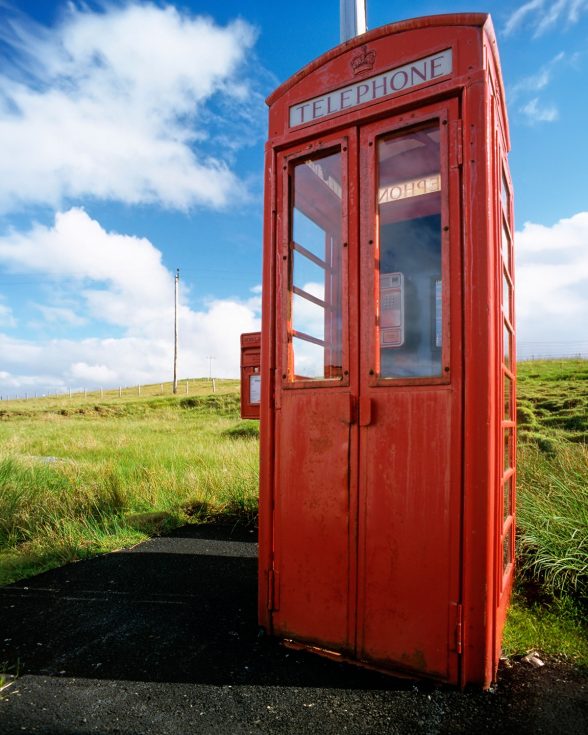
Image credit: Martin Fowler
The unique ‘Hebridean Storm Door’ variant of the K6 kiosk is only found on the Isle of Lewis. Due to very high winds in this exposed location, a special double door model was fabricated by the Saracen Foundry in Glasgow; while the standard large single door could be blown open in high winds and torn from its hinges (see last image), the double doors were more manageable to open and close, being held shut by the wind.
Only two examples are known to survive in their original locations, at Crulivig and Eneclate. The former has the Tudor crown in its moulding, dating it to between 1935 and 1953, though this kiosk is sadly now disconnected. The latter has the St Edward Crown, which was introduced in 1953 but due to protests over the use of an English insignia, the casting was switched to the Crown of Scotland in 1955 – dating the kiosk to between 1953-55.
While the Society took the statutory listing route to safeguard their future, artist William Arnold took an even more creative approach to keeping the Eneclate kiosk in use. His ‘Saving Public Telephony’ project crowdfunded more than £1,000 to drive the 1,700 mile return trip from Cornwall to Lewis last week, placing the 52 calls required annually by BT to keep the kiosk connected. Madcap but brilliant!
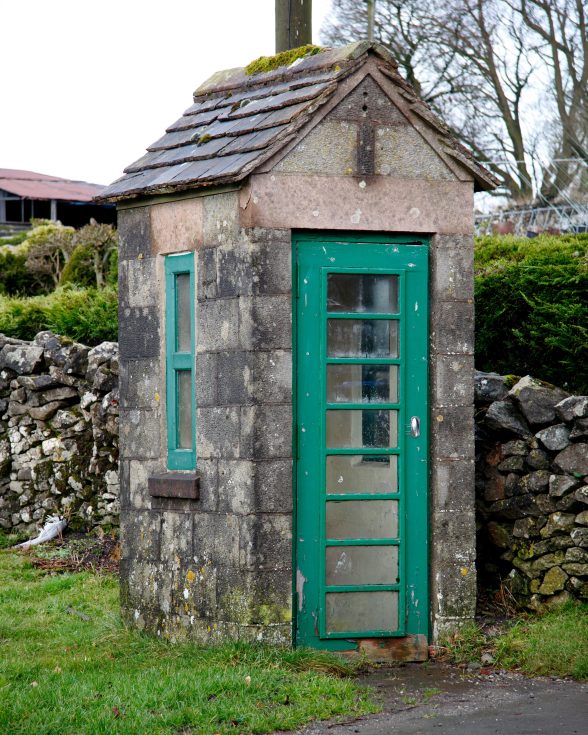
Image credit: Deborah Vernon
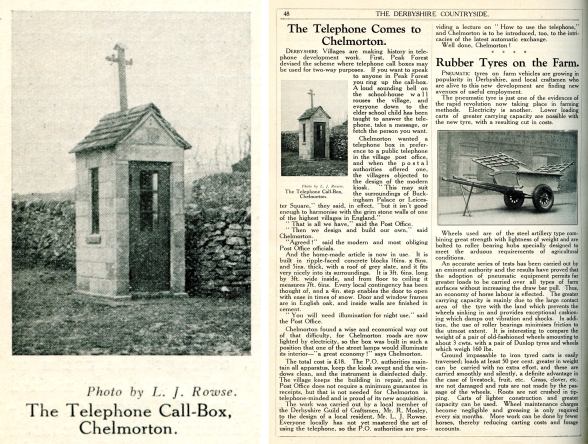
Located in the highest parish in Derbyshire, the unusual kiosk at Chelmorton dates from 1934. Villagers wanted an independent telephone kiosk in preference to a public payphone within the village post office. The model offered by the General Post Office (GPO) – presumed to be the concrete K3 kiosk, in service between 1929-35 and intended for use nationwide – was rejected as being ‘too modern’ for the rural, upland setting. An article in the Derbyshire Countryside magazine from April 1934 stated:
“This [kiosk] may suit the surroundings of Buckingham Palace or Leicester Square” they said, in effect, “but it isn’t good enough to harmonise with the grim stone walls of one of the highest villages in England.”
“That is all we have,” said the Post Office.
“Then we shall design and build our own” said Chelmorton.
“Agreed!” said the modern and most obliging post office officials.
Derbyshire Guild of Craftsmen member Mr R. Moseley created a unique kiosk to the designs of a local resident Mr L.J.Rowse, in a Derbyshire vernacular using local materials to suit the sensitive rural setting. Built for a cost of £18 in ripple-faced concrete blocks, with a pitched slate roof, cement rendered internally, with a sturdy English oak door painted in countryside green. A four-inch step was also incorporated to allow the door to open during the frequent winter snows experienced in the Peak District.
Only one other freestanding stone telephone kiosk is known to exist, at Pittencrieff Park, Dunfermline, Fife (1928), listed at Category B.
Courtesy of Richard Bradley
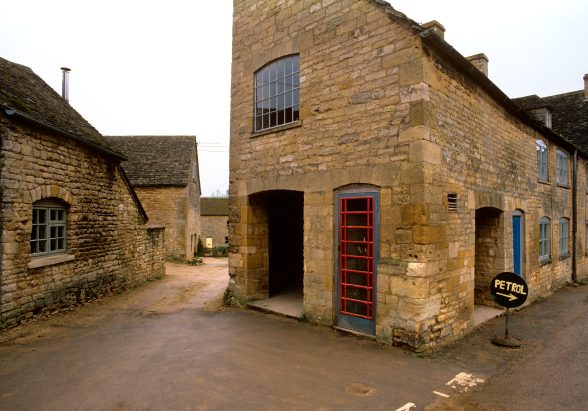
Image credit: travelib prime
The great agricultural depression of the 1870’s hit the village of Guiting Power, Gloucestershire very hard and by the beginning of the 20th century, its houses were in a dilapidated state. In the 1930’s a Ms. Moya Davidson began to buy up properties in the village in order to ensure that they continued to be rented to local people.
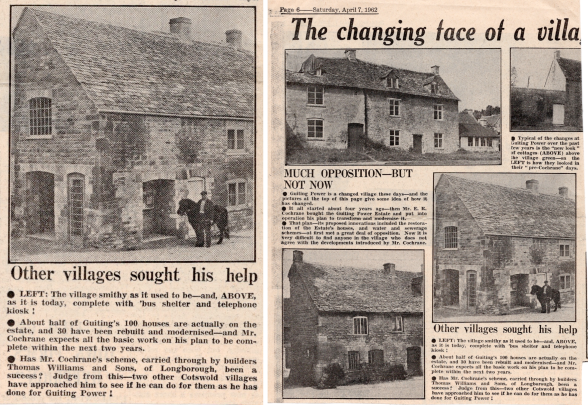
Mr Raymond Cochrane acquired the Estate in 1958 for agricultural research purposes and continued the restoration work begun by Davidson. Over the course of several decades, some 40 houses were internally modernised, externally restored and re-roofed, with water and sewerage also improved. It was as part of this modernisation programme that the former Blacksmiths shop was remodelled to incorporate a telephone kiosk, at some point between 1958 and 1962.
Led by Longborough-based builders Thomas Williams & Sons, the 18th century former Blacksmiths shop facing the village green was sensitively remodelled to incorporate a bus shelter and parish noticeboard beneath Cotswold limestone alcoves, with a public payphone built into the corner. This highly unusual kiosk is accessed via a K6 model door painted in Dark Battleship Grey with red glazing bars – a colour scheme permitted by the GPO in national parks or areas of outstanding natural beauty.
Today only three other examples in their original rural colour scheme are thought to be in existence; at the National Telephone Kiosk Collection at Avoncroft Museum, Worcestershire; the Royal Crescent in Bath (Grade II), and at Pinkney, Wiltshire. Only one other telephone kiosk built within another building is known to be listed; that at Hambleden Post Office, Buckinghamshire (Grade II)
Credit: Upper Windrush Local History Society
On 6 August 1986, a K3 concrete telephone kiosk (designed in 1929), located outside the Parrott House at London Zoo, became the first listed telephone box in Britain. The then Environment Minister, Lord Elton, signed legislation that allowed telephone kiosks to become listed buildings, making a ‘trunk’ call at a press event in the zoo with Azizah the elephant.
It followed the enormously successful ‘Take It As Red’ campaign by the Thirties Society (forerunner to the Twentieth Century Society), launched the previous year in response to BT’s modernisation programme. This scheme saw thousands of the classic red K2 and K6 kiosks, designed by Sir Giles Gilbert Scott, unceremoniously removed and scrapped, leading to a public outcry.
The campaign has resulted in more than 3,000 kiosks across the country being added to the National Register since 1986, with countless more adopted by local communities and saved from destruction. It was revived in 2007 to fight for the even rarer 1960s K8 kiosk, with 32 of these now nationally listed.
The campaign was resurrected again in 2024, with listing applications submitted for three exemplars – one each in England, Scotland, and Wales – of the widely unloved 1980s KX100 and KX300 kiosks. Designed by design firm David Carter Associates, these utilitarian models are often derided as ‘ugly’ and accused of ‘box blight’, yet they represent the last in the line of Britain’s public telephones and proactively preserve the best examples before they disappear completely. We still await the outcome of these applications.
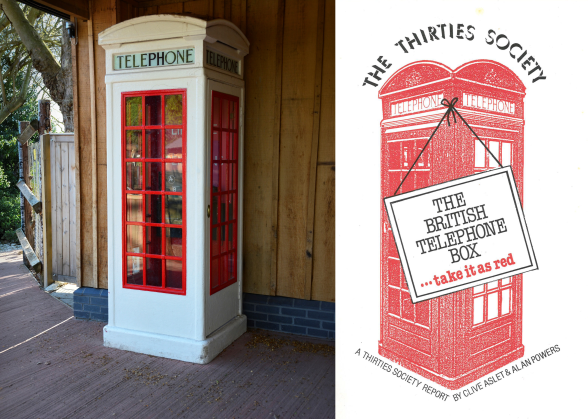
Image credit: Martin Pettitt, Flickr (L), C20 Society (R)
Oli Marshall, Campaigns Director, C20 Society
“The Twentieth Century Society has been the guardian of Britain’s iconic telephone boxes for over 40 years, and the battle to save them has arguably been the most successful heritage campaign in history, with more than 3,000 examples now protected. Despite being largely obsolete items of street furniture, they remain an internationally recognised symbol of British design excellence and a reassuring reminder of the way we used to live – think of them as the village stocks, cattle troughs or mounting blocks of the mid-20th century.
To mark the anniversary of the first ever telephone box listing, we’ve gone all the way back to the beginning: identifying three quirky and historic kiosks that have been previously been overlooked, but we believe should now be added to the national register. Dating from the 1930s, 50s and 60s, they were all designed for their particular rural locations, and demonstrate a wonderful regional variety in something that can often appear uniform.”
Become a C20 member today and help save our modern design heritage.