This website uses cookies
This website uses cookies to enable it to function properly and to analyse how the website is used. Please click 'Close' to accept and continue using the website.


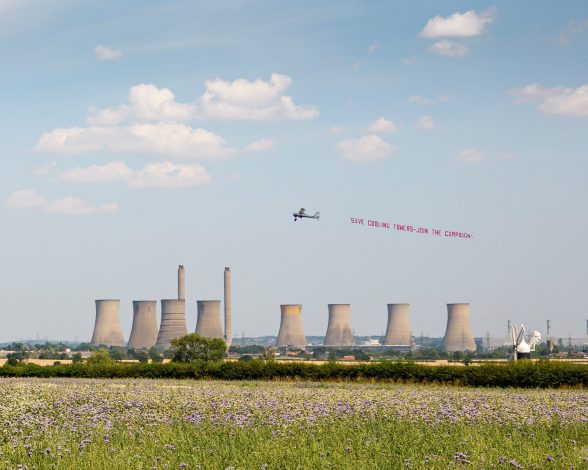
Image credit: Gareth Gardner
Is it a bird? Is it a plane? No, it’s our Save Cooling Towers banner over Megawatt Valley!
With C20 Society’s recent AGM taking place in Nottinghamshire, we couldn’t pass up the opportunity to pay a ‘flying visit’. Chartering a light aircraft, we took our campaign message to the skies above the former West Burton Power Station and North Leverton Windmill – industrial heritage of the 20th and 19th centuries respectively.
The stunt came as sources at EDF Energy confirmed the demolition of the first four 350ft cooling towers at West Burton is scheduled for Autumn 2026, with the remaining four towers expected to fall in mid 2027. With the final four towers at Fiddlers Ferry in Merseyside also due to go before the end of 2026, this will leave just 25 power station cooling towers remaining across Britain, from a peak of 240 towers in the 1960s.
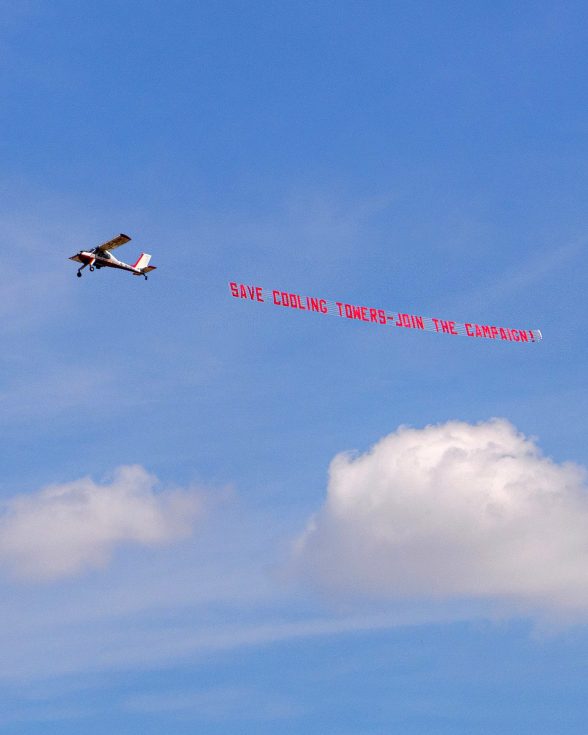
Image credit: Gareth Gardner
‘A work of great style’
Built 1961-67 to designs by Architects Design Group with landscaping by Derek Lovejoy and Associates, West Burton won a Civic Trust Award – the first to be given to a power station – for its “outstanding contribution to the surrounding scene…[as] an immense engineering work of great style which, far from detracting from the visual scene, acts as a magnet to the eye from many parts of the Trent Valley”.
It was decommissioned in 2023 and despite a Historic England report grading West Burton as the post-war power station with the highest architectural and historical importance, a Certificate of Immunity from listing has been extant from 2022-2027. West Burton has been on C20 Society’s Risk List since 2023.
Acknowledgements
Huge thanks the indefatigable Gareth Gardner and Luke O Donovan behind the lens, Laura Mark and family, and Tow Planes for making this little adventure possible.
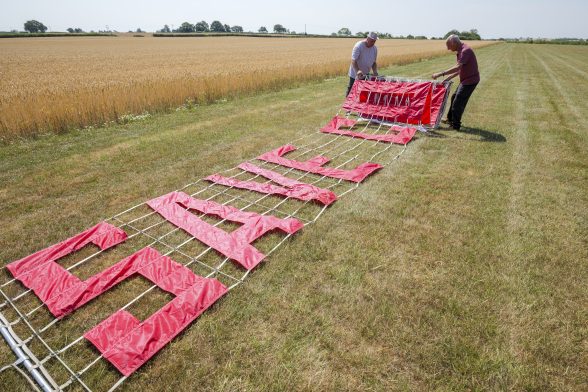
Image credit: Gareth Gardner
Cooling Towers Campaign
To date, Historic England’s advice to the government (DCMS) has been that cooling towers ‘do not have the architectural interest requisite for listing’, and that ‘at the moment there are no plans to preserve a cooling tower’, only to ‘work closely with power companies to ensure a photographic record is secured before loss’. Almost all remaining examples of cooling towers are covered by a COI (Certificate of Immunity from Listing) which legally prevents them from being designated for a period of 5 years – during which period they are scheduled for demolition. We profoundly disagree with this approach, and and urging all concerned to fully explore the alternatives.
The Twentieth Century Society is calling for at least one set of cooling towers to be preserved via listing designation and remain in ongoing discussion with the national heritage bodies in England, Scotland and Wales. We’re also working with architects, artists and engineers to explore viable approaches for how they might be repurposed in the age of sustainability.
Post-war power stations were absolutely vast, often 400-800 acres – or the size of 200-300 football pitches. The footprint of a cluster of 8 cooling towers takes up less than 2% of that. We say, why not retain the towers and integrate them into the new plans for the wider site? Be it for clean power infrastructure, affordable housing, new industries, art and education, a country park or any other use.
The British landscape is dotted with the remnants of power generation and infrastructure from previous centuries, from smock windmills to mill chimney stacks, bottle kilns to gasholder frames. Long after the sails have stopped turning and the furnaces have been extinguished, these functional structures have gradually assumed the status of regional and national landmarks. The cooling towers of post-war power stations are simply the latest example – a majestic and invaluable part our twentieth century industrial heritage.
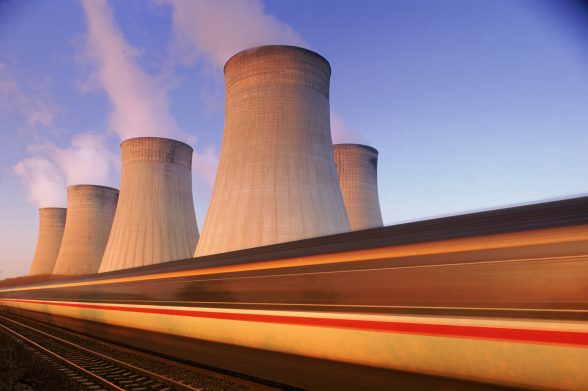
Image credit: David Noton
Become a C20 member today and help save our modern design heritage.