This website uses cookies
This website uses cookies to enable it to function properly and to analyse how the website is used. Please click 'Close' to accept and continue using the website.


October 2026 - Paddington Library, Westminster
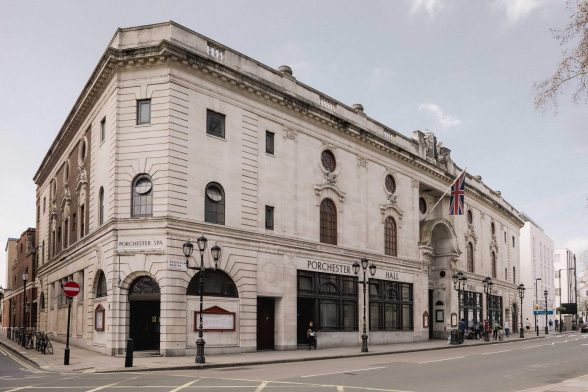
Image credit: Murray Clarke Photography
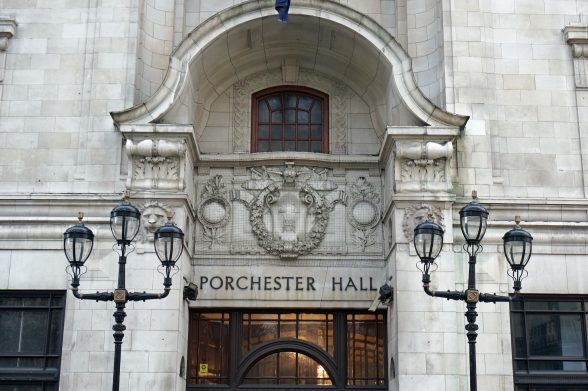
Photo by David, CC BY 2.0 (Creative Commons)
Paddington Library, Porchester Hall, Bayswater – Herbert Shepherd, 1923-29
by Clare St George
Paddington Library is at the end of my road. It is no Bibliothèque Nationale, nor Biblioteca Vasconcelos, but it is an essential part of civic life in Bayswater, my neighbourhood in West London. Situated within the Porchester Centre – a relatively well-preserved Classical Beaux-Arts building designed by Herbert Shepherd in the 1920s – Paddington Library has witnessed and been subject to the changing demographics and technologies of reading through the twentieth century.
Through photographs, drawings, and other printed ephemera stored at Westminster Archives, I glimpsed the building’s animated history. Through them, I witnessed an architecture founded on the civic ambition of its benefactors, articulated through clear and confident design, and responsive to the needs and pressures of its changing community.
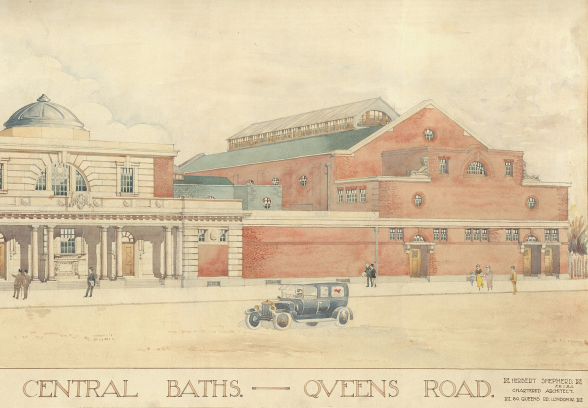
Courtesy of Westminster Archives
Over a century ago, the Public Library Act of 1919 formed the basis of the UK’s modern library system, allowing individual councils to establish and fund library services through decentralised networks. While the Act unlocked funding for Paddington Library (which had until then been informally located in a resident’s home in nearby Westbourne Grove), it was the Paddington Baths and Wash-Houses Committee who had campaigned for the building. The total project, which includes swimming pools, Turkish Baths, and assembly halls, was completed in two phases between 1923 and 1929. The Porchester Centre was later listed in 1994 as ‘an exceptionally complete and grand civic complex of the 1920s,’ with a ‘range, quality and coherence of the public spaces, which are particularly elaborate for the period and survive very well.’
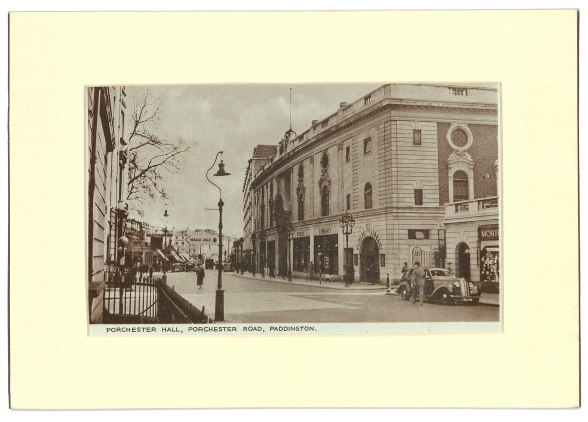
Courtesy of Westminster Archives
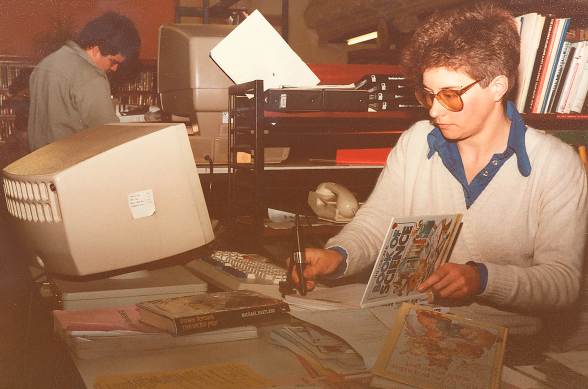
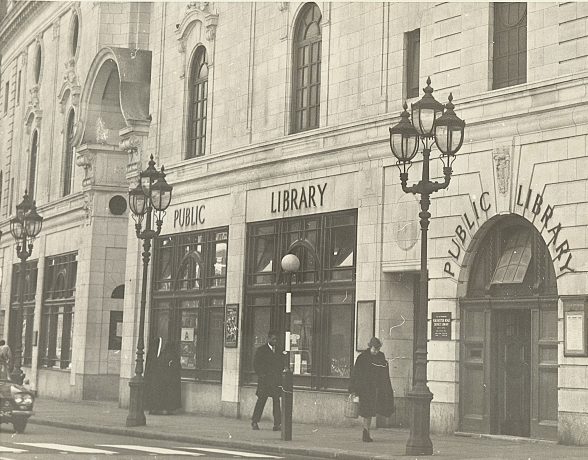
Paddington Library is situated on the ground and basement levels of the Centre, its main reading room visible through the generous windowpanes from a street level: well-lit, inviting, unobtrusive. This space has served the local community for nearly a century. For many overseas students, and for the arrival of the Windrush generation to West London in the 1950s, the library proved a vital civic space for reading and study. As local historian, Roger D. Williams, wrote of the crowds in his book ‘A History of Paddington Libraries: 1850-1965’, ‘Opening [later] until nine o’clock brought only a slight improvement. The problem was of accommodating both readers and the stock of 16,000 volumes, which were by now stacked on top of the seven-foot shelves were in places double-banked, and filled every available space.’ Books and readers proliferated for many years. In one photo from 1985, a sign announces that books across multiple South Asian languages are now available – a reflection of the increasingly diverse ethnic mix of the area throughout the 1970s and 80s, which also saw Jewish, Greek, and Arab communities integrating into the local population.
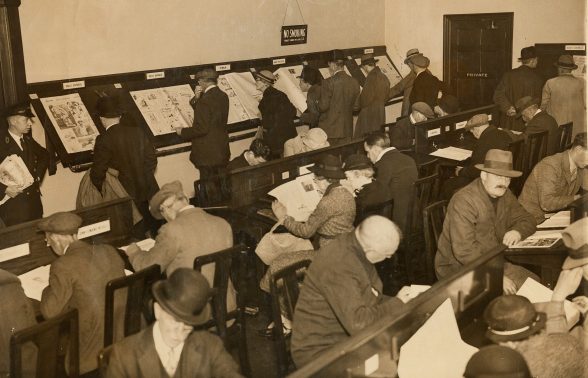
Courtesy of Westminster Archives
To accommodate its ever-increasing stock, the library underwent successive renovations. The 1987 refurbishment, captured in an excitable pouring of posters, booklets, and flyers in Westminster Archive, promised a host of resources for its readers beyond traditional lending and reference models. This included: open access for records, cassettes, and compact discs; two listening points for headphones; a special section for teenagers including paperbacks, career material, and college prospectuses; a section of large print books and talking books for readers with ‘poor vision’; a printer for information stored on microfilm; comfortable and ‘plentiful seating’; a disabled-access lift; and a fax machine.
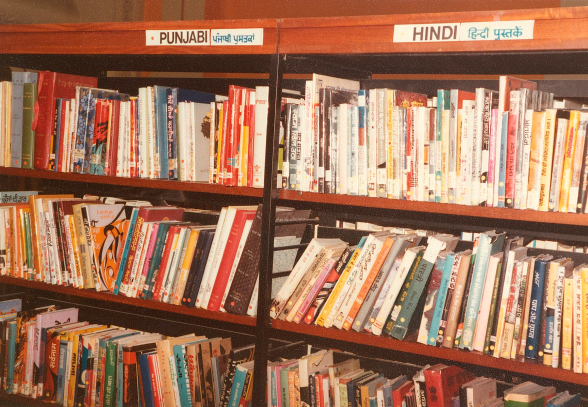
Courtesy of Westminster Archives
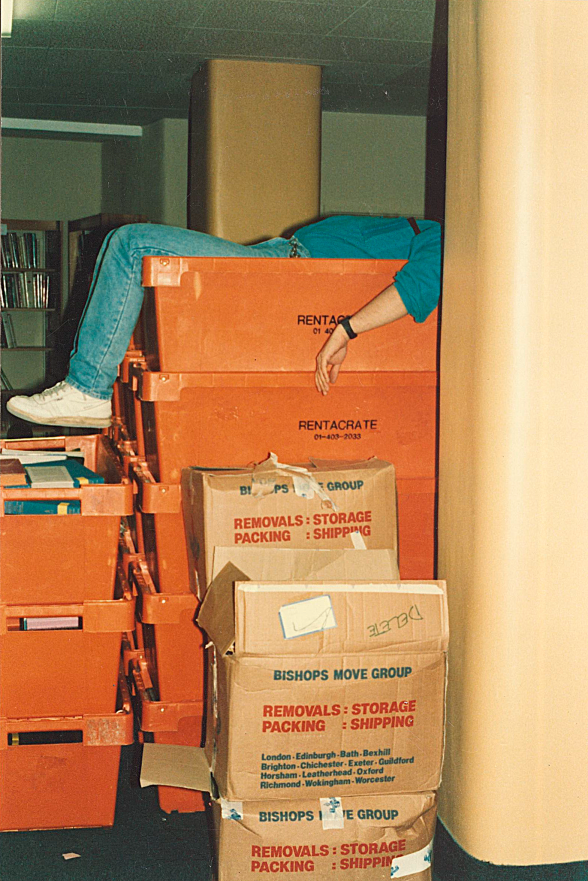
Courtesy of Westminster Archives
Each of these changing tools for reading, searching, skimming, scanning found their way into Shepherd’s original reading room without redescribing the building itself. In the 1990s, new computer terminals were added – met with excitement by the young people photographed crowding around chunky monitors. Ever practical, the accompanying hand-drawn allocation for these terminals was less concerned with architectural detailing of the room than with how these information technologies could be negotiated into an existing floor plan. I also discovered a map for houseplant distribution (again, hand-drawn), from roughly the same time. I might generously call these ad hoc sketches something to the effect of ‘informational’ and ‘landscape’ engineering. I would certainly call them a ‘testament to the librarian’, to the anonymous caretakers who have, over decades, dedicated themselves to creating a functional, modern, and welcoming environment.
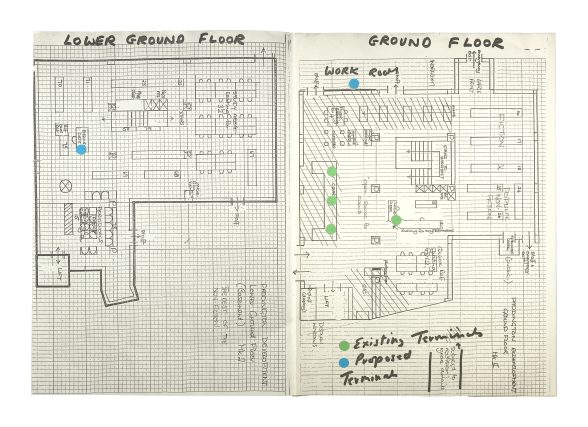
Courtesy of Westminster Archives
Courtesy of Westminster Archives
For an architect, the public library is a design brief where one can be both intensely practical and intensely hopeful; it is an opportunity to design a circumscribed utopia where knowledge and community are the primary materials at hand. But these opportunities, given significant cuts to public funding, are few and far between. Since 2016, the BBC reports, more than 180 council-run libraries have either closed or been transferred to volunteer groups, about 950 libraries, roughly one-third of those remaining, have had their opening hours reduced, and around 2,000 library jobs have disappeared.
This precarity is also compounded by a new, competitive, architecture for ‘knowledge’ storage and retrieval: the data centre. Antithetical to the core principles of the public library, the data centre removes readers from direct access to text, is intensely private in its functioning, and (as recent whistleblowers have reported) ingests books, removing them from physical circulation and, potentially, from a democratic model of reading. Even before data centres were making headlines, calls to protect libraries elicited strong support from writers, artists, filmmakers, community organisers over decades, with Ali Smith summarising the issue in her short story collection, ‘Public Library and Other Stories’:
Ali Smith
Despite this wider context, Paddington Library has fortunately survived, helped perhaps by its location within a comparatively wealthy council. This has not been without difficulty. In 2021, flash flooding destroyed many books in the basement, triggering a refurbishment effort that only fully completed this year.
On the notice board following the recent renovation: chess clubs, second-language English lessons, dog walking, computer courses for senior citizens, bicycle repairs. Paddington Library is home to functions both noble and benign, practical and creative, communal and niche. In doing so, it sustains something of the original fantasy of its benefactors in the 1920s – and perhaps even further back, to the classical public buildings that had fascinated the Edwardian imagination, evidenced in the antecedent neoclassicism of the Beaux Artes: that of a workable, multi-use, civic space.
I have voted in the assembly hall next to Paddington Library, recycled my old trainers and batteries at its entrance, produced forms and posters on its printers, attended its workshops when feeling lonely, distracted, desperate to get out of the house. The first book I checked out – Simon Jenkin’s A Short History of British Architecture – prepared me for the interview that landed me a job in architectural publishing. I am grateful for the ways that this space, campaigned for and designed a century ago, has supported my daily life and its minor and major trajectories.
Courtesy of Westminster Archives
Within the Twentieth Century Society, it is now accepted that our understanding of architecture ‘worth saving’ must extend to those buildings that play a secondary role to the activity taking place within them. These are buildings that are amended and adapted over time, quite apart from the frenzied coverage of political – or even architectural – media. Paddington Library is neither a prominent nor spectacular example within such circles, but its presence in Bayswater is nevertheless remarkable. In an era of eroded community spaces, the vitality of buildings such as the Porchester Centre (and within it, Paddington Library) is hard to overstate, though perhaps easy to take for granted. Following the Library’s reopening this September, I was reminded once again of the importance of these long fought-for physical spaces. Libraries provide a tangible and accessible place that people can go to when in need of companionship – be that in a book or a fellow human. I hope that the library serves the community for years to come. And I wish the same for other communities, and other library buildings, throughout London, the United Kingdom, and beyond.
With immense thanks to Paddington Library and Westminster Archives.
Author: Clare St George is a writer and editor living in London. She plans to exhibit her archival research on Paddington Library in an upcoming exhibition titled ‘100 Years of Reading’. She currently runs an architectural and design newsletter, ARCHETYPE, and works in publications and research at a global architectural practice.
Look for past Buildings of the Month by entering the name of an individual building or architect or browsing the drop down list.
Become a C20 member today and help save our modern design heritage.