
This website uses cookies
This website uses cookies to enable it to function properly and to analyse how the website is used. Please click 'Close' to accept and continue using the website.


Sunwin House, Bradford

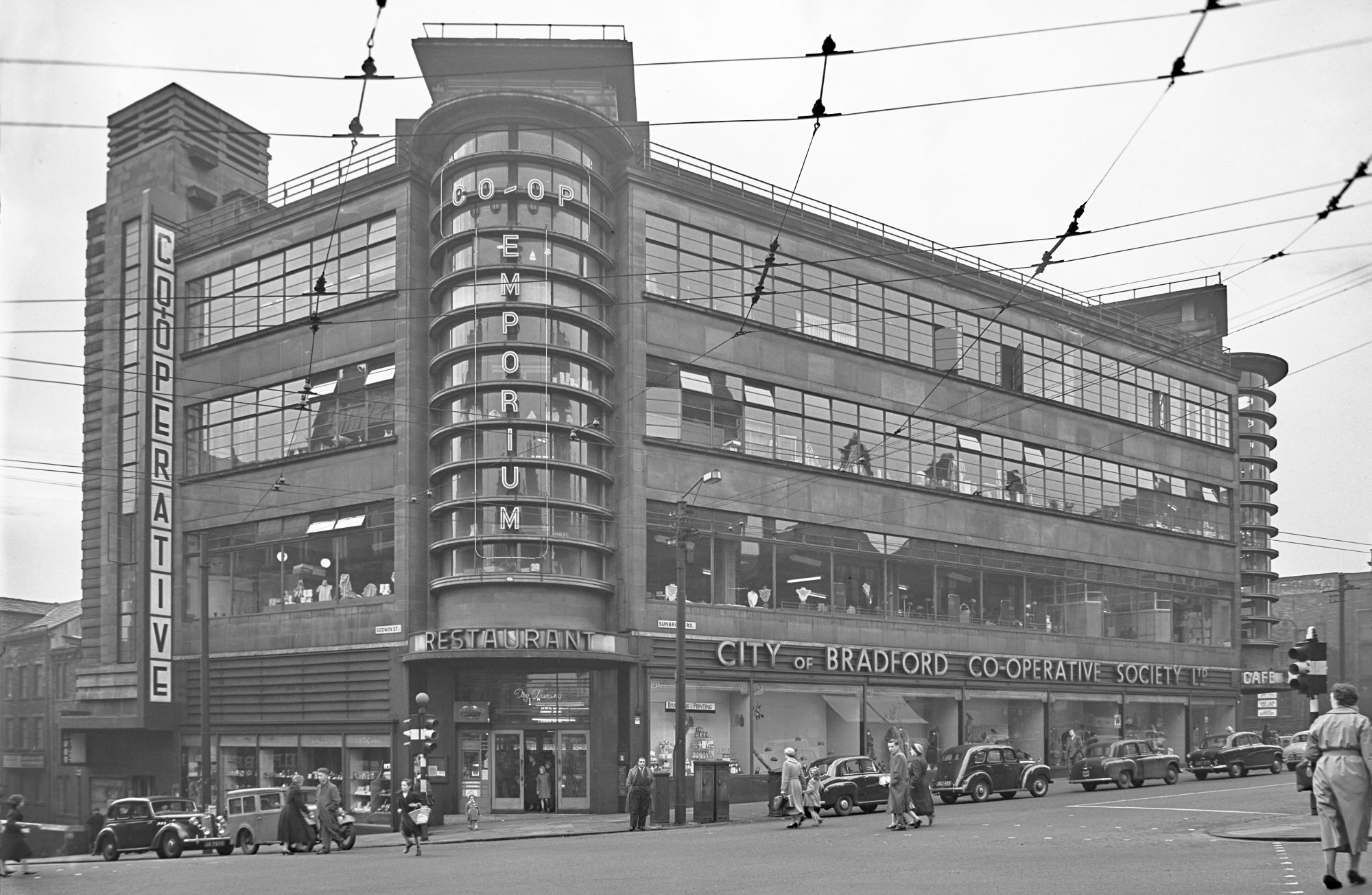

W.A. Johnson, 1935-36
Risk: Neglect
In a city known for its handsome Victorian architecture, the opening of Bradford Co-operative Society’s new emporium in 1936 must have been the ultimate shock of the new. W.A. Johnson’s Sunwin House (a portmanteau of the street names Sunbridge Road and Godwin Street, at whose intersection it stands) was heavily influenced by German architect Erich Mendelsohn, particularly his designs for the Schocken Department Store in Stuttgart (1924-26), and brought sophisticated International Modernism to West Yorkshire.
The two fully glazed semi-circular towers at either corner of the store are boldly capped by square pavilions, with a glamour that matches that of the domes on the nearby Alhambra Theatre (1914) and recently restored New Victoria (later Odeon) Cinema (1930). Internally, this was an early and influential example of the open store principle, with lifts and stairs tucked around the edges of the shopping area, and the first escalators to be installed anywhere in a Co-op store. Its virtually unaltered appearance, both externally and internally, is extremely rare and the building was Grade II listed in 2006. The Co-op sold up in 2005, and the building was latterly occupied by the retailer TJ Hughes. That business entered administration in 2011 and the building has remained empty ever since. In 2019 the Architectural Heritage Fund (AHF) awarded a project viability grant to a contemporary theatre company to investigate its potential as a multi-use cultural space, yet the store was sold to a local investment company and its future remains uncertain.
Faced with a wave of closures across the country post-Covid, C20’s Department Stores campaign has seen some encouragingly positive case studies emerge, with multi-use models leading the way. Several combining smaller retail and hospitality use on ground and lower floors, with more varied uses like co-working office spaces, gyms, university campuses, community facilities, food markets, makers studios, and repair shops on the upper floors. Despite the challenges these buildings can present – their sheer scale, deep floor plates, high energy costs – with the right vision and a sympathetic developer, it can be done. With Bradford in the spotlight as UK City of Culture 2025, hopes are high that Sunwin House could find the impetus required to dazzle once more.
Write to Bradford Council Planning and Conservation team to urge action: planning.policy@bradford.gov.uk

Become a C20 member today and help save our modern design heritage.