
This website uses cookies
This website uses cookies to enable it to function properly and to analyse how the website is used. Please click 'Close' to accept and continue using the website.


Broadwall Housing, Lambeth Image credit: James Brittain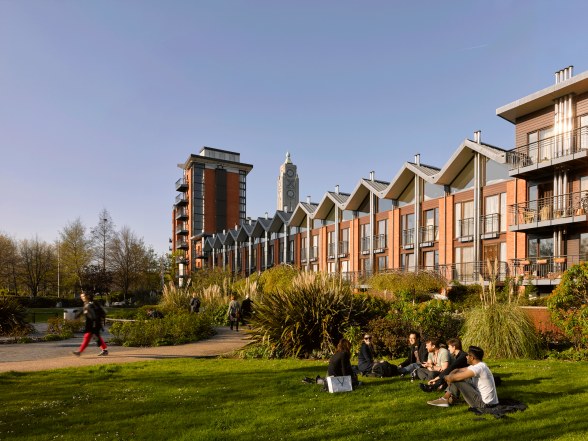
Broadwall Housing Development
Lambeth, London
Lifschutz, Davidson, Sandilands
1995
By the mid-1990s, the South bank of the Thames had become an extreme study in imbalance. Major employers such as Shell and IBM brought more than 50,000 workers into the district each day, and the cultural landmarks of the Festival Hall and National Theatre drew thousands more at peak hours. Yet the number of people able to live in the tight patch between Waterloo Station and Borough Market had dwindled to roughly 5,000. North Lambeth was at a low ebb for socially oriented housing: a place defined by a transient daytime population and increasingly hollowed out after dark, threatening to become one of London’s most unsettled urban corners.
Commissioned by Coin Street Community Builders, Lifschutz Davidson Sandilands’ Broadwell Housing Development offered, if not a panacea, a clear-sighted and humane alternative. The scheme, 11 family houses with gardens, five two-bedroom flats and ten one-bedroom flats, was shaped through close collaboration with prospective tenants, who articulated two priorities: homes that felt recognisable and robust, and layouts capable of adapting to changing circumstances. LDS took these demands seriously, designing a development that was both architecturally distinctive and unusually sensitive to long-term patterns of occupation.
The result is a row of rippling gabled roofs that unfurl southwards from the river, giving each home its own identity while settling into a silhouette that feels part inner-city terrace, part riverside promenade. Privacy is protected by modest, shielded street façades, while large areas of glazing facing the park open up the interior life of each dwelling with an inviting generosity. Materially, the combination of brick, Iroko hardwood fenestration and weather boarding has matured beautifully, acquiring the kind of patina that only careful detailing allows. The ensemble is animated by bright metal chimneys and by a slim nine-storey pencil tower that playfully echoes the enduring industrial profiles of the nearby OXO Tower (another Coin Street landmark) and Bankside Power Station.
Each tenant is a member of the cooperative that manages the buildings and is responsible for periodic maintenance, and the longevity of this system is testament to a success that occurs, unsurprisingly, when time, care and respect is afforded to people’s housing needs. In a city where community-led housing has been pushed steadily outward, Broadwall endures as a reminder that the centre of London need not be ceded entirely to capital and consumption.

Become a C20 member today and help save our modern design heritage.