
This website uses cookies
This website uses cookies to enable it to function properly and to analyse how the website is used. Please click 'Close' to accept and continue using the website.


Hope House, Hampton Image credit: Raf Makda – VIEW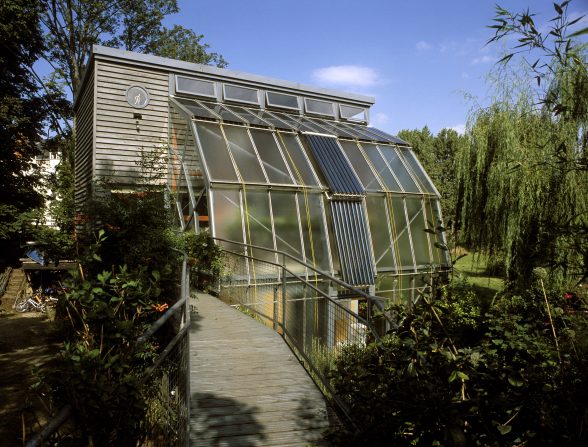
Hope House
Molesey, London
Bill & Sue Dunster (ZEDfactory)
1995
Bill Dunster is famous for his career-long quest to achieve environmental sustainability; as a student in the 80s he designed a housing estate run on solar power and, later, his work on Nottingham University’s Jubilee Campus was awarded the 2001 RIBA Sustainability Award. In 1999, Bill and his wife Sue co-founded architectural practice ZEDfactory – headquartered at Hope House – and in 2003 received a Stirling Prize nomination for bedZED, the UK’s first large-scale mixed use sustainable community. Here, fashioned in their own home, was a pioneering ideological and architectural testing station for sustainable housing that preceded and paved the way for the Dunster’s groundbreaking housing schemes.
In some photographs, and from some angles, Hope House appears to emerge from within a swampland: trees surround the abode, solar electric panels and thermal collectors adorn the outer surfaces, and a raised, recycled-steel gangway that connects the living space to the street adds to a sense of treetop wildness.
Hope House was built to sit on the suburban flood plain of South-West London and is nestled at the convergence of the Mole and Ember rivers, just upstream from where the Thames skirts the perimeter of Hampton Court Palace. Toponymists propose that this particular River ‘Mole’ might come from the Latin mola (a mill), and there are 20 mills noted along the river in the Domesday Book. Indeed, there is something timeless and industrial in Bill Dunster’s signature, two-and-a-half storey, south-facing conservatory and the way that it cascades from the house as if from a water wheel. Approached from the east, its side profile evokes the palatial glass halls of fin-de-siècle empire exhibitions from Glasgow to London; a fragment of the master’s house, long-dismantled, long-forgotten, found teeming with life naïve to its previous conurbations.
Internally, a thermally massive and flood resistant ground floor acts as a large radiator, and a serpentine arrangement of flexible ventilation ducts transports warm air upwards through a further two timber-framed storeys. A spiral staircase, encased in glass bricks, runs from top to bottom. A testament to patience and true to its name, the house was conceived as a work-in-progress, and environmental upgrades were introduced when and where they were affordable, culminating in a zero-carbon certification in 2007. Built using locally sourced materials and labour, there is nothing flamboyant about the Dunster’s achievement; rather, much of the temperature regulation is achieved by opening and closing windows between the house, the conservatory, and the outdoors. Instead, Hope House serves to demystify sustainability altogether, its understated smartness and beauty a clear and pertinent reminder that optimistic, low-carbon architecture is not only possible but well within reach.
Become a C20 member today and help save our modern design heritage.