
This website uses cookies
This website uses cookies to enable it to function properly and to analyse how the website is used. Please click 'Close' to accept and continue using the website.


Photographer’s Hide, Northamptonshire Image credit: NMLA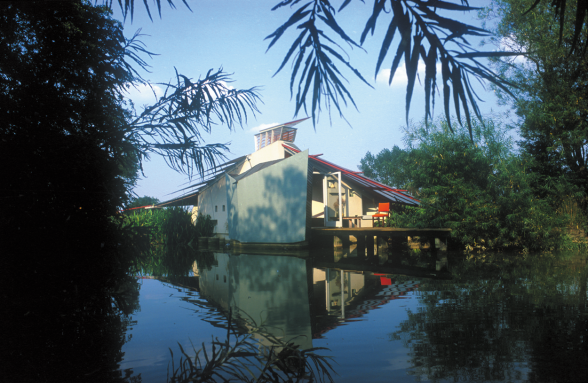
Photographer’s Hide
Níall McLaughlin
Foxall, Northamptonshire
1995
Upon winning the inaugural BD Young Architect of the Year award in 1998, Niall McLaughlin stated of his work that “the history of the site is the starting point for architectural speculation.” Resting by a pond, in a Northamptonshire field populated by the husks of concrete silos and host to the buried remains of a wartime surveillance bomber, McLaughlin’s first major project – a zoomorphic hideout – represents the triumph of an architecture whose stories and context are both surface and elusive.
The farmland surrounding this ‘Shack’ was once a US air base, and during WW2 flights of B-24 black ‘Carpetbagger’ bombers took off from the nearby woods, carrying with them supplies for resistance activities on the continent. These missions required significant adaptation to the planes: the bombers were disarmed and painted a glossy pitch black, and their ‘belly turret’ was detached so that each machine flew with a gaping hole in its fuselage allowing supplies to be dropped, and reconnaissance photographs to be taken. Stripped of their explicitly destructive potential and capable only of covert observation and transportation, swarms of these altered creatures took off to return with images of foreign fields, rivers and roads.
After the war, the land was used as a nuclear missile site before its abandonment in the mid-1960s. By 1994, the plot was owned by a photographer, Gina Glover, who had begun to think about capturing the surface of a pond on film. Together, McLaughlin and Glover started opening up the site of an old bomb pond, “previously stagnant and lost in a tangle of briar”, oxygenating the water with fish, water plants, and filtration. Dragonflies quickly returned to the waters. The early designs for the building compared Glover’s lens, hovering above the pool, to the reconnaissance flights from the nearby base, and a “dark, wing-like form” began to emerge at the edge of the water.
Built for £15,000 without any construction drawings, McLaughlin and builder Simon Storey (whose father was, synchronicitously, a reconnaissance Spitfire pilot) instead used models to design, explain, and construct the tiny building. The resulting structure threatens to screech into flight at any moment, and is allowed to flap, flex and deflect in the high winds that frequent the location. Indeed, project engineer Tony Hayes felt it necessary to incorporate slender steel rods into the construction, to ensure that the building remained pinned to the ground, and unable to fly or float away.
The wing ‘members’ are surmounted by perforated metal canopies, the roof is of plywood, fibreglass, polycarbonate and metal, and the dainty cupola which holds down the cascading crown suggests by turns the head of a bird, a cockpit, or watchtower. The whole structure is an experiment in light, each window facilitating a stage of the photographic process, with sunshine pouring in from countless openings at different speeds, reflecting off the water outside and indoor surfaces like a hideout-cum-magic lantern. It remains a wondrous, dreamlike place to make photographs.
Become a C20 member today and help save our modern design heritage.