
This website uses cookies
This website uses cookies to enable it to function properly and to analyse how the website is used. Please click 'Close' to accept and continue using the website.


Queens Building, Emannuel College, Cambridge Image credit: Dennis Gilbert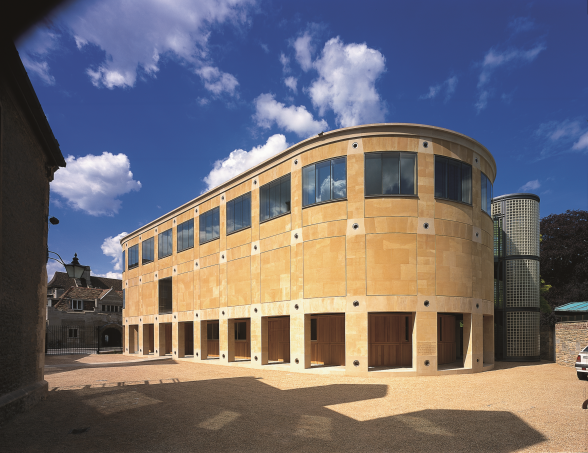
Queen’s Building
Emmanuel College, Cambridge
Hopkins Architects
1995
Close observers of the Coming-of-Age List will note a similarity between Emmanuel College’s Queen’s Building and the 2024 list’s Glyndebourne Opera House, a free-standing Hopkins building with a performance space at its heart, oval in shape, and a roof structure of combined timber and steel trusses. Certainly, Queen’s Building provides a continuation of much of the successes of both Glyndebourne and indeed Nottingham’s Inland Revenue Centre (Queens Building’s layered lead roof, shared with the IRC, can be traced back to a shared origin in the David Mellor factory). It is a succinct statement of Hopkins’ structural principles and satisfying ambiguities, which was awarded the 1995 RIBA Regional Award, RIBA Award: Architecture in Education, the Royal Fine Art Commission Trust: Building of the Year Award, and was shortlisted for the inaugural Stirling Prize.
That said, there is an elusive virtuosity to this creation that invites closer inspection: from above, a view of the building and its wider plan reveals a monolithic pill, somewhat cellular in form, inserted into a quadrangular, largely baroque host. This implant sits with a stillness that boarders stealthy, its beautiful glass-brick stairwell protruding periscopically outwards like the eye of a snail. From the ground there is a seamlessness in the way the performance space occupies its august context. Enclosed by a colonnade and clad in Ketton limestone, there are formal and material references to Christopher Wren’s nearby College Chapel that reassure the viewer of a sensitivity to the building’s intellectual and architectural milieu.
Continuing the slight sense of deception, the building is studded by ventilation ducts that are reminiscent of ‘putlock’ or ‘putlog’ holes. These cavities are often found on castles and other medieval buildings, caused by the removal of scaffolding poles after construction to reveal a series of structurally unthreatening voids. A similarly concealed structural technique lurks throughout Hopkins’ building: the 400mm thick loadbearing walls are insufficient to resist the outward thrust of the floors and ceilings, yet where a buttress might once have solved such an issue (but ruined the simplicity of form), Hopkins opted for a hidden system of tensioned stainless-steel rods within the piers. As such, the building’s loadbearing masonry is structurally honest but reliant on hidden steel, with is a sumptuous creativity in the execution of a building that is quietly complex, simultaneously both enigmatic and traditional.

Become a C20 member today and help save our modern design heritage.