
This website uses cookies
This website uses cookies to enable it to function properly and to analyse how the website is used. Please click 'Close' to accept and continue using the website.


Tees Barrage, Stockton-on-Tees Image credit: Mike Kipling Photography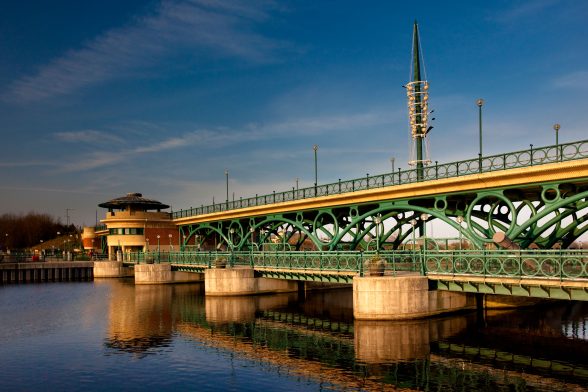
Tees Barrage
Stockton-on-Tees
Napper Architects
1995
In the late 1980s the tidal waters of the Tees, banked by derelict engineering works and other hallmarks of Thatcher’s economic ‘Wilderness’, routinely revealed silty mudflats; home to lugworms, mud shrimps and molluscs. The Teesside Development Corporation (TDC), formed in 1987, deemed these intertidal ecosystems unsightly, and in 1990 a Barrage was commissioned to permanently conceal the biodiverse muck, and celebrate the entrance to the TDC’s flagship Teessdale development site. The resulting collaboration between the Napper Collerton Partnership and Ove Arup & Partners is a curious example of late Postmodern infrastructure, including a collection of road and footbridges to cross the waters, two pavilions, a fish ladder and a canoe slalom.
The architectural centrepiece of the Tees Barrage is the dynamism between the light, elevated tubular steel filigree tracing of the central bridge, and the massiveness of the supporting concrete barrage piers. The orb-like lamps and ‘Tower of Lights’, 29 metres high, lift the design further out of the rushing water, and combine with a peculiar sense of timelessness in keeping with the barrage’s Po-Mo verve. At night the streetlamps float above the road bridge like fireflies hatched from the buried mud, and who is to say that in ceasing the tide’s ebb and flow the barrage did not inadvertently scramble time itself as, squinting, phantasms of Paris’ Pont des Arts blur with vacant British Steelworks, and the nearby monumental Tees Transporter Bridge reappears in what is both mirage and homage to the tides and traditions of the North East. At the height of its output there were 91 blast furnaces in the Teesside Steelworks area, by 1979 only one remained. Indeed, the steel carried sensitively across the Barrage’s design in roundels, arches, decorative handrails and structural tubing is an aide-mémoire of this great Teesside heritage, and a nod to a site once defined by mineral fortunes.
The vitality of Napper’s architectural storytelling was recognised at the time, receiving the 1995 British Construction Industry award, RTPI Regional Award, Environmental Excellence Award and Natural Stone Awards, as well as the 1996 Concrete Society Certificate of Excellence. Truly, the Barrage has pulled together local landmarks, memories and material legacies with restorative effect and now sits as an example of the area’s regeneration: neighboured by an International White-Water Centre that offers canoeing, kayaking, paddleboarding, and raft building, the surrounding region is a hub for activities that would not be possible without the tidal control afforded by the Barrage.
Become a C20 member today and help save our modern design heritage.