This website uses cookies
This website uses cookies to enable it to function properly and to analyse how the website is used. Please click 'Close' to accept and continue using the website.


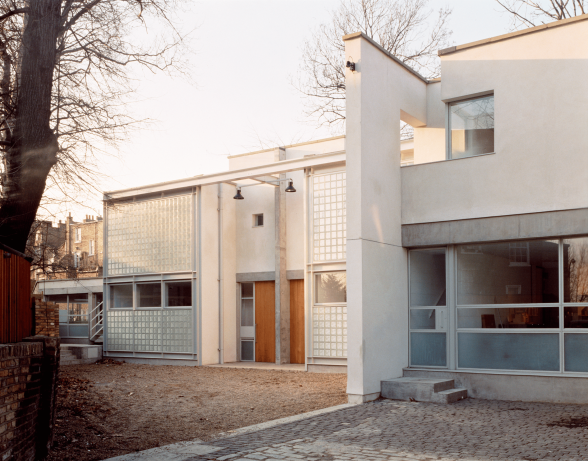
Image © Jeremy Cockayne for Arcaid
C20 is delighted that Sir David Chipperfield’s first UK building has been designated Grade II, following a listing application by the Society in January 2025. 1 Cobham Mews Studios in Camden, North London, was developed between 1987-89 on a backland site and former scrapyard off Agar Grove. It served as the office and studio of David Chipperfield Architects for over 20 years, until they moved to new premises in 2011.
It has subsequently been the studio of landscape architects Gustafson Porter + Bowman, who have plans to vacate and convert it from office to residential usage, creating 4 new dwellings within the existing building. The Society supports a residential conversion in principle, but recommended listing the building to ensure any changes are carefully managed and sympathetic.
The listing designation comes at David Chipperfield Architects is celebrating 40 years in practice and other notable projects are currently in the news. Their award-winning The River and Rowing Museum in Henley-on-Thames (1998) will permanently close in September after long-running financial struggles. Meanwhile the former U.S. Embassy in Grosvenor Square, London (1960) re-opens as the Chancery Rosewood Hotel next month, after a decade long conversion project led by Chipperfield. The former embassy is the only UK building by architect Eero Saarinen and was Grade II listed in 2009 following an application by the Society.
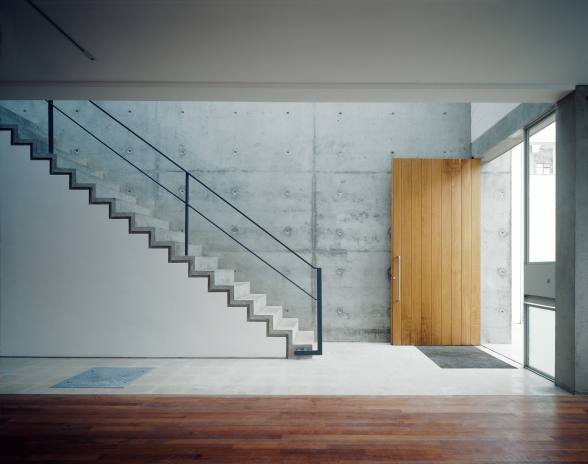
Image © Jeremy Cockayne for Arcaid
‘English minimalism’
Built on an awkward triangular plot, bounded by the back gardens of surrounding properties on all three sides, the building has only one visible ‘elevation’. The geometry of the site and a planning condition that stipulated avoidance of overlooking neighbours, led to a design that favoured top-lit loft-like studio spaces. Chipperfield has stated that the ‘controlled views’ of the building drew inspiration from Victorian artists’ studios and the traditions of Japanese architecture. Its architectural language also unmistakably references that of the pre-war Modern Movement, with its flat rendered walls, expressed steel frame, glass blocks and ribbon windows particularly evoking Pierre Chareau’s Maison de Verre, Paris (1928-1932).
As with the exterior, the interior spaces use a simple palette of materials, detailed with precision and refinement. The spatial interest is accentuated by the controlled admission of natural light from above. Flat surfaces of plaster and steel are contrasted with tonal and textural contrasts in the glass bricks and oiled hardwood floor; materials and surface plains meet with clarity and precision. The heavy, braced timber doors and shuttered concrete spine wall introduce the tactile quality of craft objects.
Chipperfield set up his practice in 1985, when modernism’s critical and public reputation was at a low ebb. His early work can be seen as part of a wider project of reclaiming or recovering modernism by returning to its diverse origins and by emphasising its ability to address the particularities of place and culture. It’s also characteristic of what C20’s Alan Powers has described as ‘English Minimalism’; a pared down, materials-based approach related to modernism, an aesthetic which was popularised in the 1990s by high-end retailers and restauranteurs.
The notification report also praises the building’s “sophisticated composition realised with clarity and rigour,” as well as the “spatial interest of the interiors… accentuated by the use of natural daylight”. The listing recognises Cobham Mews Studios as embodying “the formative influences on Chipperfield’s approach and the themes and preoccupations which thread through his subsequent work”.
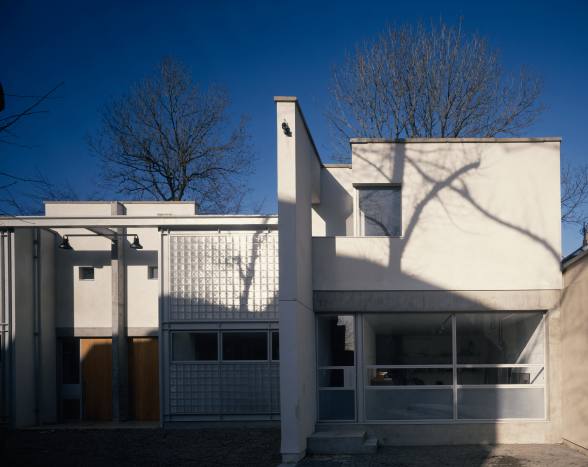
Image © Peter Cook for View Pictures
David Chipperfield Architects
Sir David Chipperfield (b.1953) is aBritish architect of international importance. Chipperfield graduated from Kingston School of Art in 1976 and the Architectural Association School of Architecture in 1980. He then first worked under Douglas Stephen, Norman Foster and Richard Rogers before establishing David Chipperfield Architects in 1985. It grew into a global practice, which now has offices in Berlin (Est. 1998), Shanghai (2005), Milan (2006) and Santiago de Compostela (2022).
Chipperfield has received numerous honours and awards for services to architecture: he was appointed Commander of the Order of the British Empire (CBE) in 2004, he was knighted in 2010, received the Royal Gold Medal of the Royal Institute of British Architects (RIBA) in 2011, was appointed Member of the Order of the Companions of Honour (CH) in 2021, and in 2023 he won the Pritzker Prize.
The practice has an international reputation for expertise in design process and for the enduring quality of its projects. Working across the private and public sectors, the practice’s diverse portfolio includes celebrated cultural, residential, education, retail, workplace and civic projects. Among the their major completed works are the rebuilding of the Neues Museum in Berlin, Amorepacific headquarters in Seoul and The Bryant in New York. The practice has received over 100 awards for design excellence.
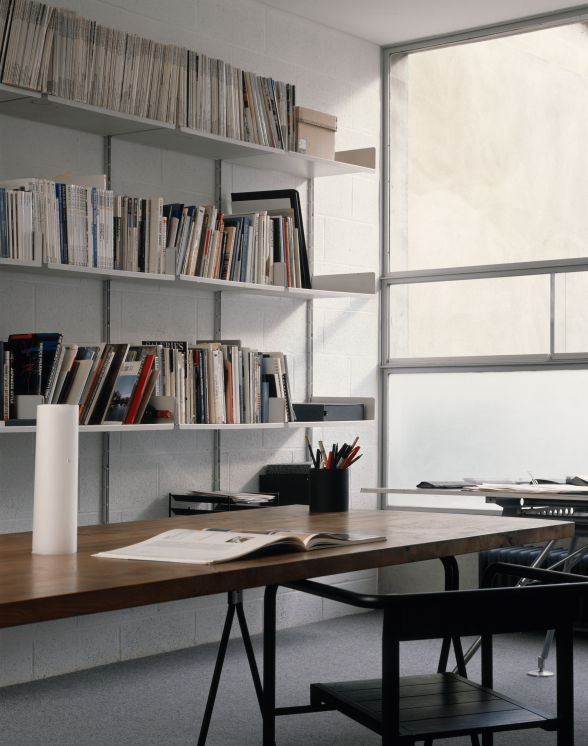
Image © Peter Cook for View Pictures
Comments
Catherine Croft, Director – C20 Society
“Before the Neues Museum and the Hepworth Wakefield, before the Pritzker Prize, there was 1 Cobham Mews Studio. In this modest, modernist ‘backlands’ project, we can see early evidence of the rigour and meticulous attention to detail that would later become hallmarks of David Chipperfield’s work. We’re absolutely thrilled that C20 Society’s listing application for the Studio was successful – well timed as the practice celebrates 40 years and other key early projects are on our radar for potential listing.”
David Chipperfield – David Chipperfield Architects
“Cobham Mews is an important early project for our practice. The site is completely landlocked by the gardens of the neighbouring buildings. The design and realisation of the building was totally determined by this condition, and the fact that the tree roots of the neighbouring gardens had to be protected. The lack of aspect meant that the building had to receive most of its daylight from roof lights or via small courtyards. The inspirations for the building were the typical Victorian artist studios in London, and the normal small-scale industrial buildings of the area. The building provided us with a very comfortable working space for many years.”
Become a C20 member today and help save our modern design heritage.