This website uses cookies
This website uses cookies to enable it to function properly and to analyse how the website is used. Please click 'Close' to accept and continue using the website.


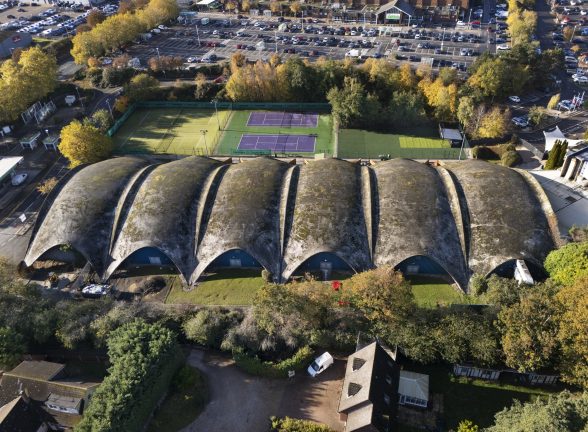
Image © Historic England
C20 is delighted that Norwich Sports Village, the only concrete shell structures in the UK to be designed by pioneering Swiss engineer Heinz Isler (1926-2009), has been Grade II listed following an application from the Norwich Society and support from C20. Constructed 1987-88 in the Broadlands area of Norwich, the project was led by Copeland Associates, in collaboration with the Swiss architects Haus and Herd. The elegant concrete forms utilise Isler’s innovative ‘inverted membrane’ and ‘plumped pillow’ method, creating a tent-like shell that is on average only 100mm thick, appearing to ripple and billow like it’s blowing in the wind.
The sports village consists of three angled ranges of concrete shells: a three-bay range containing a former ice skating rink, a six-bay range housing tennis courts and the main sports hall, with a square-plan concrete shell containing a swimming pool at the apex. A hotel block of no architectural interest is centrally positioned between the three shell structures. The site is currently operated by the David Lloyd Sports club group.
Norwich is the latest case in C20’s ongoing Leisure Centres Campaign, which has so far seen six pioneering examples designated across the country: Wrexham Waterworld (F. D. Williamson, 1967-70), Doncaster Dome (Faulkner-Brown Hendy Watkinson Stonor, 1986-89), Bradford’s Richard Dunn Sport Centre (Trevor Skempton, 1974-78) Swindon’s Oasis Leisure Centre (Gillinson Barnett & Partners, 1974-75), Bell’s Leisure Centre in Perth, Scotland (John B. Davidson, 1968) and Norwich Sports Village.
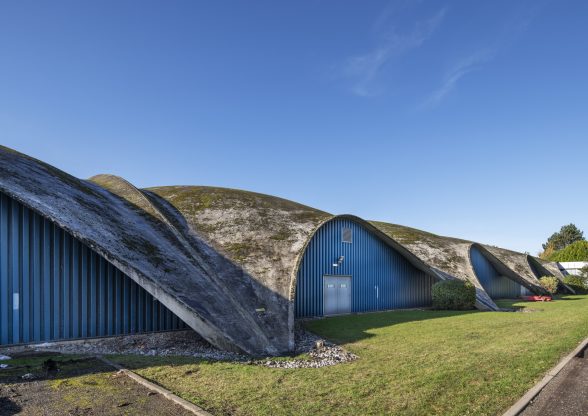
Image © Historic England
Heinz Isler
Heinz Isler (1926-2009) was born in Zollikon near Zurich, Switzerland. As an engineering student he made a special study of reinforced concrete shells and this was to become his life’s work. His first project was in 1954-1955, a concrete shell roof for the Hotel Kreuz at Langenthal, which was inspired by the form of his plumped-up pillow.
Isler designed several inverted membrane tennis halls in Switzerland, the first of which was in 1978 at Dudingen, where he designed a three-shell structure. The Norwich Sports Village also employs this design for the nine shells of the sports halls. The swimming pool shell added in 1991 is a different design with a square inverted membrane, an earlier design he first used in 1978 for a swimming pool in Heimberg, Switzerland.
Isler was a prolific designer, with around 1,000 of his shells constructed, mostly in Europe, but the Norwich Sports Village is the only building to his designs in the UK. It is also the only free-form concrete shell constructed in the UK. Four of Isler’s shells designed using the inverted membrane technique are protected by listing in Switzerland: the two triangular canopy shells of the Deitingen Süd Motorway Service Station (1968) and the Pavilion Sicli Cultural Centre in Geneva (1969), and two groups of tennis hall shells at Chaux-de-Fonds and La Tène in the Swiss canton of Neuchâtel.
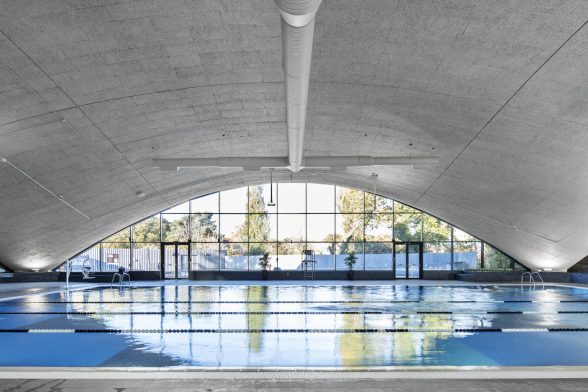
Image © Historic England
C20 Director, Catherine Croft, commented:
“The graceful, tent-like canopies at Norwich Sports Village are a masterpiece of engineering, making the super-fine 100mm thick concrete shell ripple and billow like it’s blowing in the wind. These are unique structures in the UK and we’re delighted to see them recognised with national listing. Perhaps just as importantly, they’re still well used and serving their original purpose; to provide an elegant and practical shelter for the various activities beneath – a swim, trip to the gym, or a game of tennis”
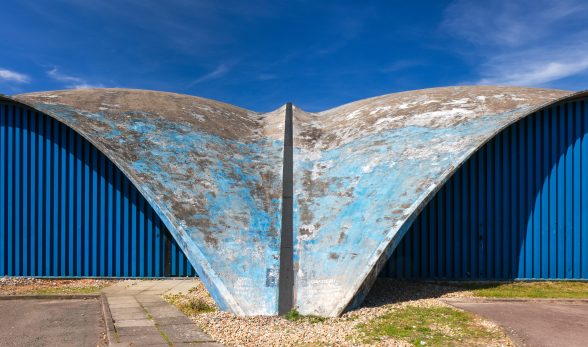
Image credit: John East

Become a C20 member today and help save our modern design heritage.