This website uses cookies
This website uses cookies to enable it to function properly and to analyse how the website is used. Please click 'Close' to accept and continue using the website.


July 2026 - Valhallabadet, Gothenburg, Sweden
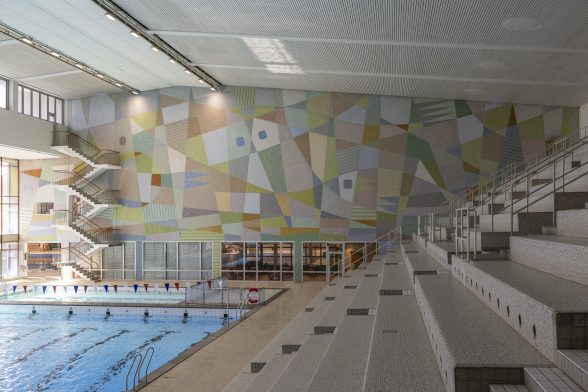
Image credit: Jonathan Hökklo
Valhallabadet, Gothenburg, Sweden
Nils Olsson, 1948-56
Entry by Veronica Hejdelind
Images: Jonathan Hökklo
Valhallabadet is a public bath and swimming hall in Gothenburg, Sweden. Opened in 1956, it represents an extraordinarily well-preserved example of Swedish welfare architecture with period details and is one of the country’s most beautiful swimming pools. For 70 years Valhallabadet has been a popular meeting place for the community, attracting nearly half a million visitors annually, but now the building is up for demolition. In 2025, Europa Nostra — a leading citizens’ movement for protecting Europe’s cultural and natural heritage — listed the pool among the 7 Most Endangered Heritage Sites in Europe, while local NGOs, architects, writers and the community are fighting to save it.
When Valhallabadet opened in 1956, it was Sweden’s largest and most modern public swimming pool. Today, the bath is one of the finest and best-preserved examples of the Swedish welfare state’s form- and quality-conscious architecture. The building manifests fundamental ideas of democracy, equality and public health in several ways. For example, class-based ticket fees were abolished, giving all visitors equal access to the various sections of the bath. Washrooms, toilets and a splash pool were built to accommodate the particular needs of children. With Valhallabadet, the public bathhouse was no longer just a place for washing and hygiene — it was foremost a place for recreation, swimming, public health and community.
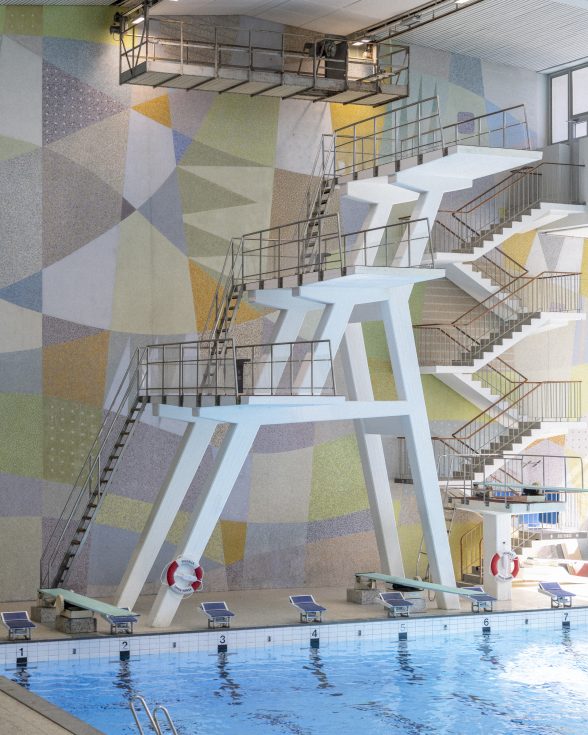
Image credit: Jonathan Hökklo
Valhallabadet was designed by the local architect Nils Olsson (1891-1951) who specialised in sports architecture. In fact, the architectural drawings for the building earned him a bronze medal in Architecture at the 1948 Summer Olympics in London — back when the Olympics had an Art Competitions. Unfortunately, Olsson died before construction of the pool had begun; the project was ultimately completed by his colleague, architect Gustaf Samuelsson (1911-1991).
Valhallabadet consists of five building volumes: a low entrance area; a foyer and changing rooms in a low part under a pleated roof; a pool area in the highest part of the building; a boiler room with a narrow chimney; and a 50-meter pool. The volumes are placed offset in relation to each other giving a small-scale impression despite the large size of the facility.
The construction technology used was new for the time. Load-bearing beams and columns in concrete allowed for freer shapes and larger openings in the walls, allowing for asymmetrical roof slopes and large window sections. The building’s concrete structure is emphasized by being visible as a framework in the facades and by being painted light gray. The compartments are filled with facade bricks in varying shades of yellow with a grooved surface, and the roof is covered with copper plates.
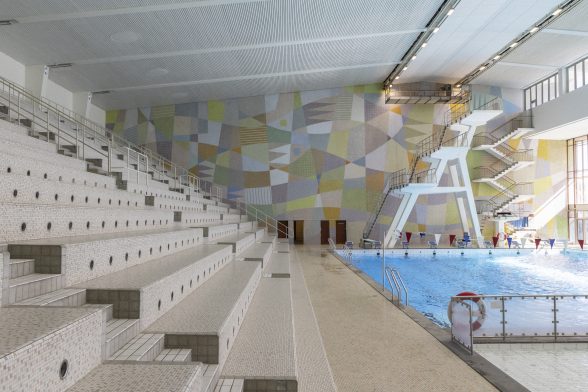
Image credit: Jonathan Hökklo
The northern part, including the entrance, offices and changing rooms, is quite closed to the outside. With few windows, it contrasts with the facades facing the park to the south, which are almost completely open, with large glass sections that look out onto the greenery. Along the southern facade a sun terrace runs just under the roof, while the swimming pool doors open out into a small park.
The interiors are built of high-quality materials throughout. The floors and walls are covered with marble, tiles, clinker and mosaic. The design of interior details such as lamps, signs, number plates, handles and knobs are typical of the period. The materials have aged very well despite extensive use.
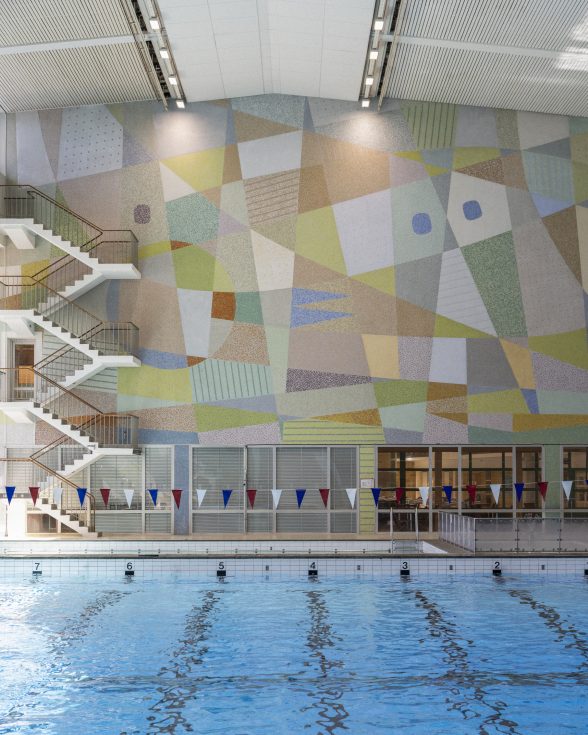
Image credit: Jonathan Hökklo
The most striking feature of Valhallabadet is the pool room, with its spaciousness and daylight flooding in through the generous window openings, the sculptural white diving tower and the stairwell running up to the sun terrace. But above all, the most prominent feature is artist Nils Wedel’s (1897-1967) giant wall mosaics that cover both sides of the room. This modernist monumental work is over 700 square meters, 14 meters high and made of thousands of small square pieces of glass, which were manufactured at the iconic Swedish Kosta glassworks. The motif features fish, wave movements and a beach ball that playfully sweeps along the walls in a horizontal movement, evoking water, sun and summer. The walls shimmer in light pastel colors, like sun reflections in water and fill the hall with a beautiful shimmer. It is a room that takes most people’s breath away.
Valhallabadet also houses a Roman bath located in the basement, inaugurated in 1959. A section with bathtubs was removed to make room for the new bath with a café. The Roman bath still exists today but no longer has any permanent staff or café. The original changing cabins are preserved, built with varnished golden brown beech. By the bath’s pool area is a decorated tiled wall from Upsala-Ekeby with a playful sea motif by the Finnish ceramist and sculptor Taisto Kaasinen (1918-1980).
Despite continuous changes and renovations throughout the bath’s life, Valhallabadet has retained its character from the late 1950s.
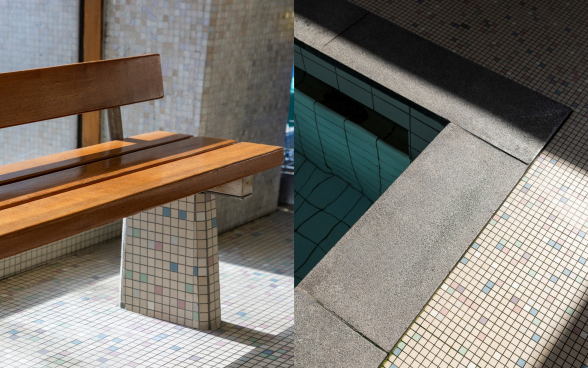
Image credit: Jonathan Hökklo
Demolition threat, public support and activism
Valhallabadet now faces demolition due to the Municipality of Gothenburg’s plans to build larger sports and entertainment facilities in the area, including a new public pool. Despite growing support from the public to save Valhallabadet, local politicians are moving forward with plans for demolition, believing it to be“outdated”. However, investigations commissioned by property owner Higab, as well as site visits by experts and interviews with the Valhallabadet’s staff, indicate that the pool can be successfully preserved and refurbished. Several alternative development proposals show that Valhallabadet can be upgraded to meet the municipality’s new capacity requirements without demolishing the existing building and in ways that save time and money and reduce carbon emissions.
The opposition to the demolition plans culminated in 2025-2026 through applications for listed buildings, citizen proposals, petitions, articles in local media and magazines and countless demonstrations, exhibitions and public debates. With the help of private contributions and support from associations, the documentary Valhalla – folkhemsbadet was produced by the local non-profit FASAD.
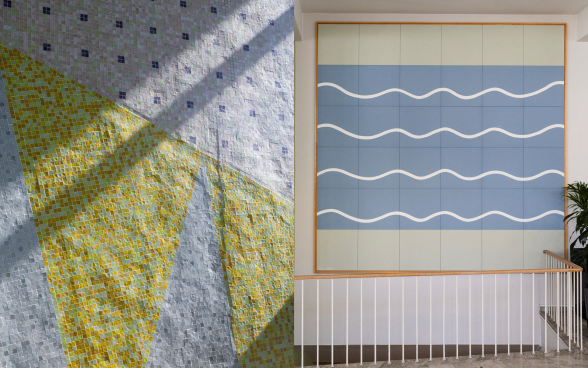
Image credit: Jonathan Hökklo
In 2025, Europa Nostra included Valhallabadet in its annual “7 Most Endangered Heritage Sites” list, which identifies the most culturally valuable buildings in Europe that are threatened with destruction. The Advisory Panel of the 7 Most Endangered Program emphasised:
“The Valhalla Swimming Hall stands for both a significant expression of the 1950s’ pioneering architecture and artistic decoration, and a breakthrough for a new public health responsibility, a symbol of changing attitudes toward public swimming. It is also an example for the rest of Europe in its exquisite design, accessibility and openness. For architectural, cultural, social, economic, and environmental reasons, the Valhalla Swimming Hall should be renovated for the benefit of both present and future generations.”
The fight to save Valhallabadet continues. In addition to FASAD, groups such as Architects Climate Action Network (ACAN) Sweden and The Gothenburg Heritage Association are petitioning and organizing for the upcoming election in September 2026. To support conservation of Valhallabadet, sign the petition here: https://www.mittskifte.org/petitions/radda-valhallabadet
Veronica Hejdelind — Veronica is a writer, art historian and swimmer, with a passion for public pools. She is based in Stockholm, Sweden. You can find her on Instagram (@vhej) and on her website: https://hejdelind.com/.
Look for past Buildings of the Month by entering the name of an individual building or architect or browsing the drop down list.
Become a C20 member today and help save our modern design heritage.