This website uses cookies
This website uses cookies to enable it to function properly and to analyse how the website is used. Please click 'Close' to accept and continue using the website.


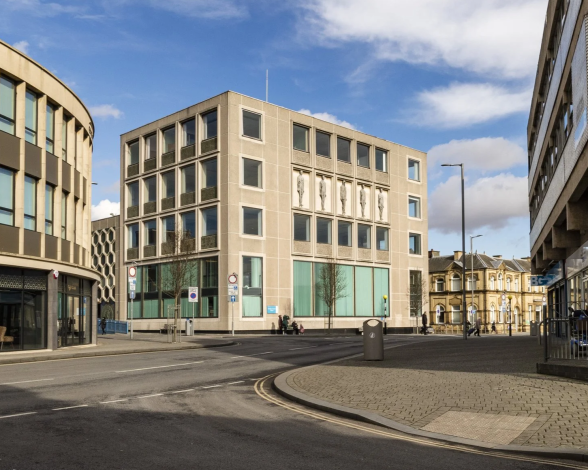
Image © Christopher Matthews
C20 Society has written to Historic England requesting an urgent spot listing assessment for the Central Library in Grimsby (1966-68), after a previous application from November 2025 was turned down due to ‘lack of threat, strategic priority or significance’.
The library has been closed to the public since March 2025 due to issues with water ingress and the discovery of asbestos, resulting in the partial decanting of collections to temporary facilities whilst structural and environmental remediation work proceeds. In January 2026, a report commissioned by North East Lincolnshire Councilors set out plans for an extensive stripping out of the building, which would cause irrevocable damage to many of its original features and irreversibly compromise the library’s architectural and heritage significance. We are particularly concerned for the significant murals and artwork within the library, with the report stating that ‘the building will have to be fully stripped out and nothing is suitable for retention’. The report estimates the building could remain closed until 2029.
Since 2013/14, the library services only occupy parts of the building due to funding constraints. In 2023, the Council outlined the allocation of £4.2 million from the government’s £20.9 million Town Fund, to carry out the refurbishment of the library building and to activate its underutilised spaces. This was never put into practice, and it was revealed in January 2025 that around £3.7 million of the budget had been reallocated to the town’s Freshney Place redevelopment project, sparking public outrage and uncertainty regarding the building’s future.
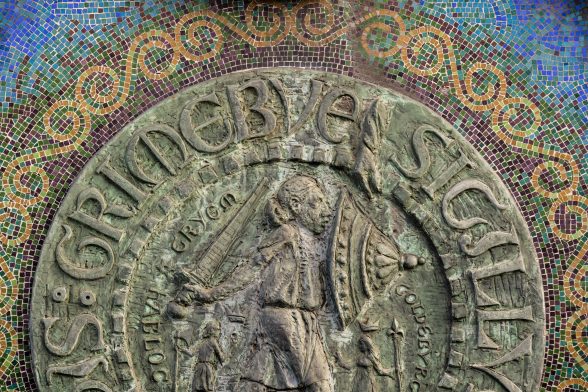
Image © Christopher Matthews
The Grimsby Central Library building was built between 1966-1968 to the designs of borough architect John Michael Milner with research by influential borough librarian E H Trevitt. It was built as a permanent replacement for its Victorian predecessor which was heavily damaged by German bombing in 1941. The highly distinctive building, which incorporates elements of Scandinavian modernism, stripped classical motifs, and brutalism, is a remarkable and nationally important example of local civic architecture in post-war period. Prominently sited in Town Hall Square, alongside Grimsby’s Grade II-listed Town Hall (1861–63) and Registrar’s Office (1867), the building not only serves as an architectural landmark but also as a living embodiment of social democratic ambition.
The steel frame structure is clad in factory-made precast concrete panels, which are finished in either white smooth concrete, Cornish granite or Derbyshire Spar Chippings. The building presents as four storeys, big windows with projecting concrete surrounds, with five bronze relief figures on the main front. The entrance is around the corner, with a grill of hexagonal units that incorporates coloured glass and resembles a beehive pattern of windows, creating varying effects in different lighting conditions.
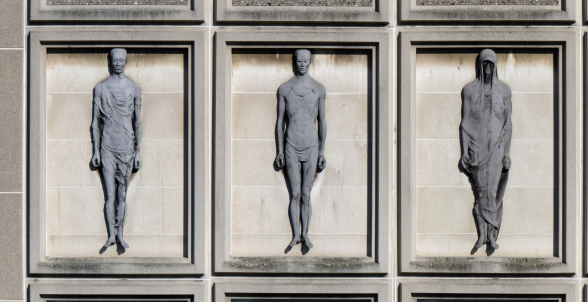
Image credits: Modern Mooch
Artwork
One of the most notable features of the library is the large amount of original artwork that was commissioned from local artists to complement the architecture, almost all of which survives in good condition. The most striking works of art on the building are the five eleven-foot-high figures on the southern façade, which faces Town Hall Square. These figures, made from fibreglass and bronze, are the ‘Guardians of Knowledge’ by Peter Todd. Todd was a well-known as the Head of Grimsby School of Art for thirty years, having taught a whole generation of local artists, including the Oscar-nominated actor John Hurt.
Next to the main entrance to the building, the sculptor Harold Gosney produced a bronze relief of the town’s seal, an enlarged copy of a thirteenth-century original that depicts the town’s founders, Grim, Havelock and Princess Goldeburgh. Gosney, born in 1937, also created the impressive concrete reliefs on nearby Abbey Walk car park and other public artworks throughout Grimsby. Behind the relief was a multi-coloured mosaic created by Anthony Cappocci, with the assistance of his apprentice, Harold Mitchell. Represented here is a sophisticated integration of historical reference with contemporary artistic techniques, creating visual narratives that connect the new building to Grimsby’s medieval origins. On the east side of the building, which faces New Street, the back staircase is lit by rows of decorative ceramic panels designed by D Morris of Laceby Pottery.
Internally there is a modernist mural by local artist David Tarttelin, featuring Apollo and the Three Muses, plus a bold terrazzo floor in the foyer, inset with vibrant coloured circles. Much of the original shelving and furniture have since been replaced, but the overall internal layout remain remarkably similar to its 1968 form. Many original fittings and fixtures are intact – particularly the distinctive vertical suspended lighting system and the steel and wood stairways.
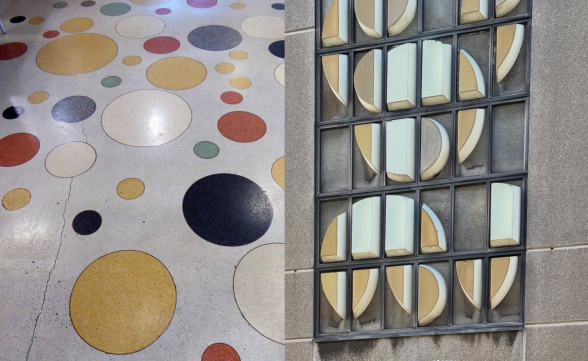
Image credits: Modern Mooch (L) Lisa Brown (R)
Owen Hatherley, writing about the building in his Modern Buildings in Britain book, said:
“Why does nobody ever talk about Grimsby central library? How is it not famous? It’s a fabulous little building…a mini masterpiece with chandeliers, mosaics, public sculpture, a wonderful double-height reading room…civic design of the highest order It’s a fantastic place but it’s not listed. It’s never ever mentioned.”
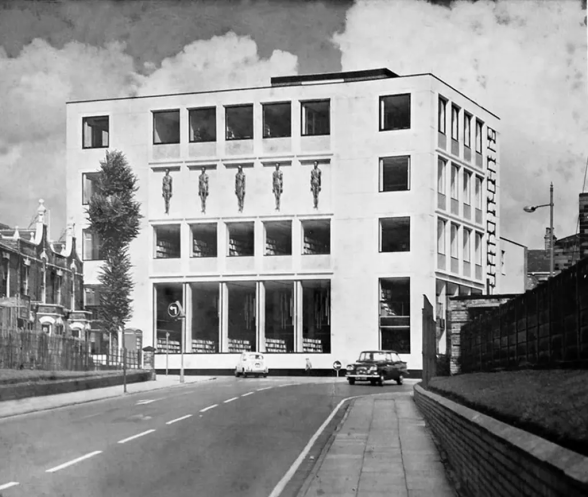
Image credit: Modern Mooch
Become a C20 member today and help save our modern design heritage.