This website uses cookies
This website uses cookies to enable it to function properly and to analyse how the website is used. Please click 'Close' to accept and continue using the website.


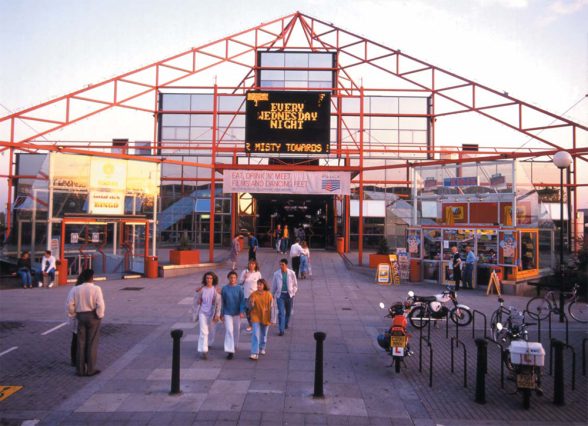
Image credit: MK Living Archive
Happy Birthday to The Point! The Milton Keynes multiplex opened 40 years ago this week on 29 November 1985, with screenings of Back to the Future, The Goonies, and My Beautiful Laundrette. Designed by architects BDP and Tibbatts Associates, the 70ft high bright red steel pyramidal remains the unmistakable landmark of the low-rise New Town skyline, with a mirrored glass ziggurat beneath and a frame illuminated in neon lights at night. As well having 10 fully independent screens, The Point introduced many cinema-going innovations and comforts we now take for granted; like cup holders and uninterrupted views from every seat, plus on-site leisure facilities like bars, restaurants, nightclubs and a disco.
After its closure a decade ago, The Point has been at centre of a long-running battle between local campaigners, politicians and heritage groups trying to preserve the building, and developers seeking to demolish it for a much-criticised new housing scheme. Having been covered by a Certificate of Immunity from Listing (COI) for a period of 5 years, which has prevented The Point from being designated as a listed building, the COI expires early next year and Historic England are now reassessing the site, with crucial new evidence recently emerging that underlines The Point’s historic significance.
While it was known to have been Britain’s first American style multiplex cinema, former AMC cinema executives Millard Ochs and Charles J Wesoky have now confirmed The Point was the first example of a multiplex anywhere outside the United States.
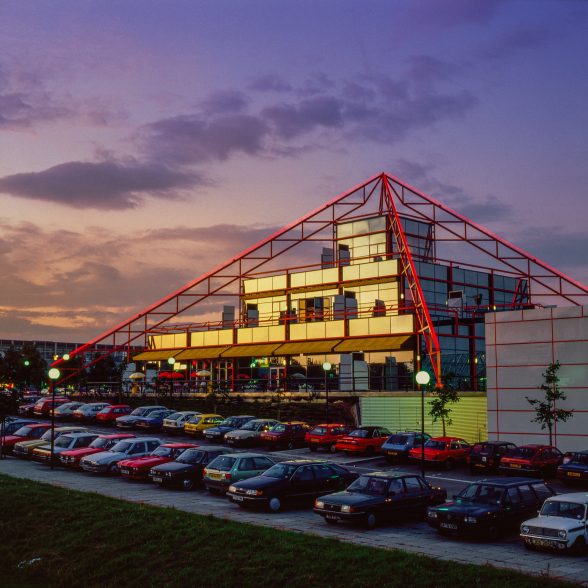
Image credit: Patrick McCarthy
‘Taking Britain back to the movies!’
By the mid-1980s British cinema-going was at a historic low-ebb, with the number of cinemas falling from 4,800 at the outbreak of the Second World War to 660 in 1984, and annual admissions declining from from £1.6 billion in 1946 to £56 million in the same timeframe.
It was in this context that Milton Keynes was chosen as the ideal location for a bold new experiment by the AMC cinema chain. As the largest and most ambitious of the post-war New Towns, it had a sizeable catchment area across the south and east of England, with ample car parking and the adjacent shopping centre to attract potential visitors.
The Point sparked a renaissance in British cinema-going and helped inspire the global proliferation of multiplexes. It welcomed more than a million visitors in its first year, doubling initial expectations of 500,000 visitors. From a single multiplex site in 1985, by 1991 there were 41 multiplexes across Britain containing 387 screens – making up a quarter of all cinema screens in the country.
A giant pyramid is not as out-of-place is it might first sound in Milton Keynes. The astrologically inclined Buckinghamshire city was reputedly designed “under a fog of marijuana smoke and Pink Floyd records”. Its central artery is Midsummer Boulevard, flanked by Silbury and Avebury Boulevards, which lead to a landscaped park of mounds and inscribed circular solar paths. All were apparently aligned with the summer solstice sunrise, after consultation with Greenwich Observatory to ensure accuracy.
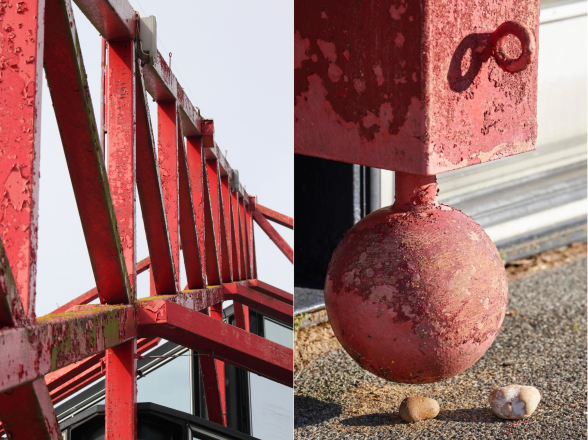
Image credit: Andy Stagg
Decline and demolition threat
The Point went into a decline after the arrival in Milton Keynes of the giant Xscape leisure complex in 2000, boasting a 16-screen cinema, indoor sky slope, shops, restaurants and a casino.
The nightclub at The Point closed in 2007 with the Odeon cinema following in 2015. In the interim, the building has provided a home for local youth charities, while grassroots campaigners launched various petitions and crowd funders in an attempt to save the building, highlighting its community value, innovative design and landmark status
A £150 million housing scheme by Galliard Homes that would have seen the demolition of The Point, was unanimously rejected by Milton Keynes City Councilors in July 2024. However this decision was appealed by the developers, who in July 2025 won approval from the planning inspector to develop the site into a 21-storey apartment block containing 487 flats.
Reacting to the news, Labour leader of the council, Peter Marland, said the decision showed a “complete disregard for the unique heritage of the city” and that the proposed scheme was “terrible in almost every single way”, citing its lack of affordable homes, “bad design” and “identikit flats”. He added: “[The Point] is just as important for the people of Milton Keynes as the Liver Building is to the people of Liverpool or St Paul’s is to Londoners – just because its newer doesn’t mean it’s any less important”
Milton Keynes Council is now receiving legal advice as to whether it can challenge the planning appeal, meanwhile Historic England is assessing whether The Point should become only the second post-war listed cinema in the country.
Film critics, Mark Kermode and Simon Mayo, of the Kermode and Mayo’s Take podcast, have recently backed the campaign, commenting: “That building is amazing. I’ve been around it and it does look exactly like a pyramid. If you are in government now – that’d be Lisa Nandy I imagine – could you get that sorted and list The Point? Thanks very much!”
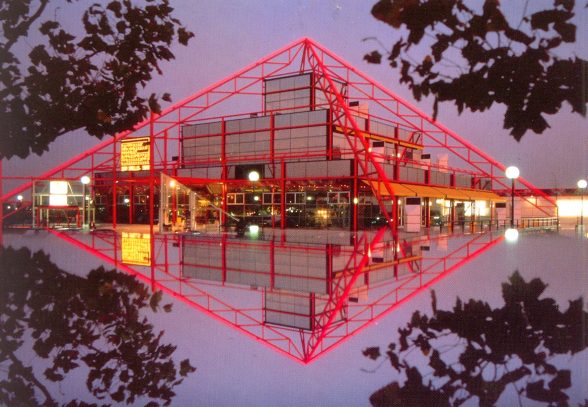
Image credit: MK Living Archive
Oli Marshall, Campaigns Director at the Twentieth Century Society commented:
“As the government plans the next generation of 21st century New Towns, we should be celebrating and preserving the best heritage of our original post-war New Towns. The Point is the most historically important cinema built in Britain since the ‘golden age’ of the 1930s and its pyramid is the indisputable landmark of Milton Keynes. Remarkably only one post-war cinema in Britain is currently listed (the 1960s Curzon in Mayfair) – it’s high time we changed that.”
Emily Darlington, MP for Milton Keynes Central commented:
“Though the site has fallen derelict in recent years, the complete demolition of The Point would be a considerable loss to our local heritage assets. It sits right besides our Grade II listed Shopping Centre, as well as sitting pride of place on our recently-launched New Town Heritage Register – it holds a special place in our New Town story, and in the memories of those who moved to Milton Keynes in the early years.
The Labour Council rejected the proposals for re-development of The Point because it failed to adequately preserve our New Town history. The decision by the Planning Inspectorate to overturn that unanimous, cross-party decision shows that they’re simply Missing the Point – urban history is history too, and we can look to the future without turning our back on what set Milton Keynes apart in those formative years of our New City.
There is no trade-off between ambition for our future and respect for our past; we have consistently outstripped national housing targets in Milton Keynes, all whilst acting to protect those heritage assets most important to our communities.”
Become a C20 member today and help save our modern design heritage.