This website uses cookies
This website uses cookies to enable it to function properly and to analyse how the website is used. Please click 'Close' to accept and continue using the website.


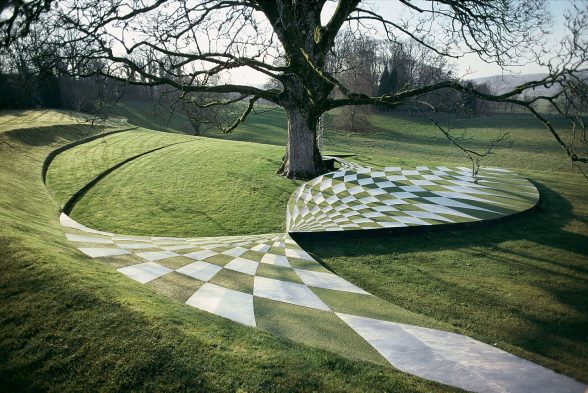
Image © The Jencks Foundation
We’re thrilled that The Garden of Cosmic Speculation in Dumfries has become a designated landscape, following assessment by Historic Environment Scotland and support from C20 Society. Developed gradually between 1988 and 2012, the Garden is a work of outstanding artistic importance by the internationally renowned landscape designer and theorist of postmodernism Charles Jencks (1936–2019), in collaboration with his wife Maggie Keswick Jencks (1941-95) and members of their close family.
The designation is the latest to arise from the pioneering Designed Landscapes of the Recent Past project. Led by Historic Environment Scotland and running from 2021-25, it sought to identify, record and champion Scotland’s modern garden and designed landscape heritage; ensuring sites dating from 1945 to the early 21st century are better understood, valued and protected.
After receiving public nominations for sites to consider through an online survey, a selection of gardens and designed landscapes was prioritised for assessment. Those designated or amended on the National Record of the Historic Environment as a result of the project include: Crawick Multiverse,(Charles Jencks, 2011-17) – the first 21st century designation of any description in the UK; Glenwhan Gardens (Tessa Knott-Sinclair, 1979 – present day), Piper Alpha Memorial Garden (Sue Jane Taylor, 1990-91) and Little Sparta (Ian Hamilton Finlay, 1966-2006).
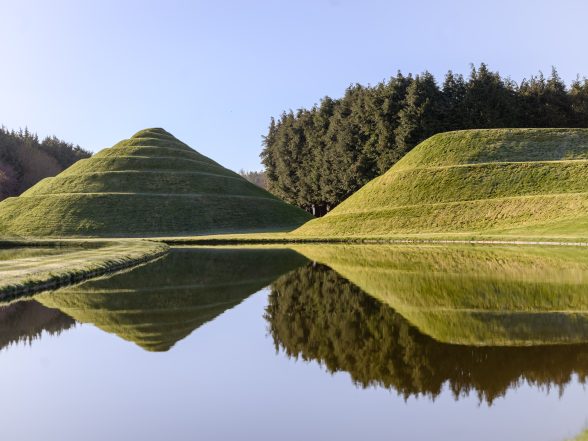
Image © John Jencks
‘A new language of landscape design’
The Garden of Cosmic Speculation is located within the grounds of Portrack House beside the River Nith, approximately six kilometres northwest of Dumfries, and covers an area of around 30 acres within the wider 300-hectare Portrack estate. It was developed as an open-ended experimental garden and land-art project from 1988, by Charles Jencks and his wife, Maggie Keswick, whose parents had owned and lived at Portrack since the 1950s. Their principal collaborator on the project was Alistair Clark (Head Gardener at Portrack Estate, now retired). It evolved in a deliberately gradual manner, often using practical circumstances as a springboard for the addition of new design ideas and installations, and latterly with the involvement of other immediate family members including daughter Lily and son John Jencks. Portrack House and its grounds remain a private family home, and work continues at the garden to this day (2025).
Mixing architecture and landforming with sculpture, planting and inscription, Charles Jencks wrote that they were trying to develop ‘a new language of landscape design’. The garden features forty major areas with gardens, bridges, landforms, sculpture, terraces, fences and architectural works.
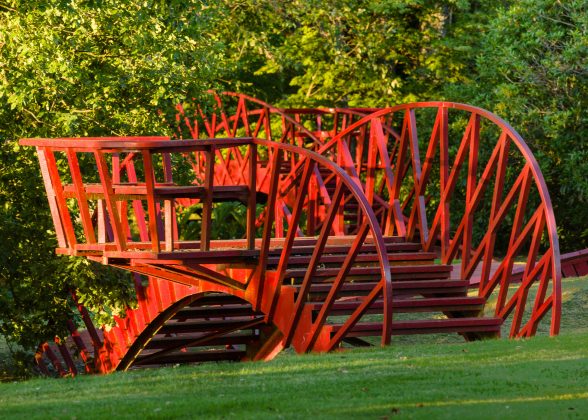
Image © John Jencks
Linear Paradise Garden / Clare’s Walk: This is a long area of planting in informal beds running adjacent to the south approach road, contrasting colourful borders with tall shrubs and trees. It was created in the later 19th century upon and between mounds of earth moved from 19th century levelling works to create a lawn for games such as bowls or croquet. This element of the garden was tended by Maggie Keswick’s mother during the mid- 20th century and has been retained largely unaltered.
Snail Mound, Snake Mound and Slug Lakes: The Snail and Snake mounds (begun 1988) are the earliest examples of Jencks’ large turfed and stepped landforms, which became a signature motif. They are of exceptional importance within the context of Jencks’ later landscape work.
The twisting, elongated Snake Mound is over 100 metres long and 20 metres high at its tallest point. Its S-curve draws inspiration from the shape of wave-form energy. The spiralling Snail Mound, with its twin-path ascent and descent, alludes to various things including architectural archetypes, the double-helix of genetic DNA, the shape of solar systems and galaxies, Chinese garden traditions, and ideas relating to human progress and pilgrimage. The landforms also resonate with the borrowed natural landscape of undulating hills, visible several miles away to the northwest.
The Slug Lakes are two curving swimming ponds, on the site of an earlier area of boggy marshland, bisected by a narrow turf causeway. A curve or tail of land extends out into the main body of water to the east. Two red curving bridges, with forms inspired by fractal geometry, cross narrow streams exiting the lakes to the west. Smaller arched red bridges connect pathways through the verdant low-lying area of the garden to the north of the lakes.
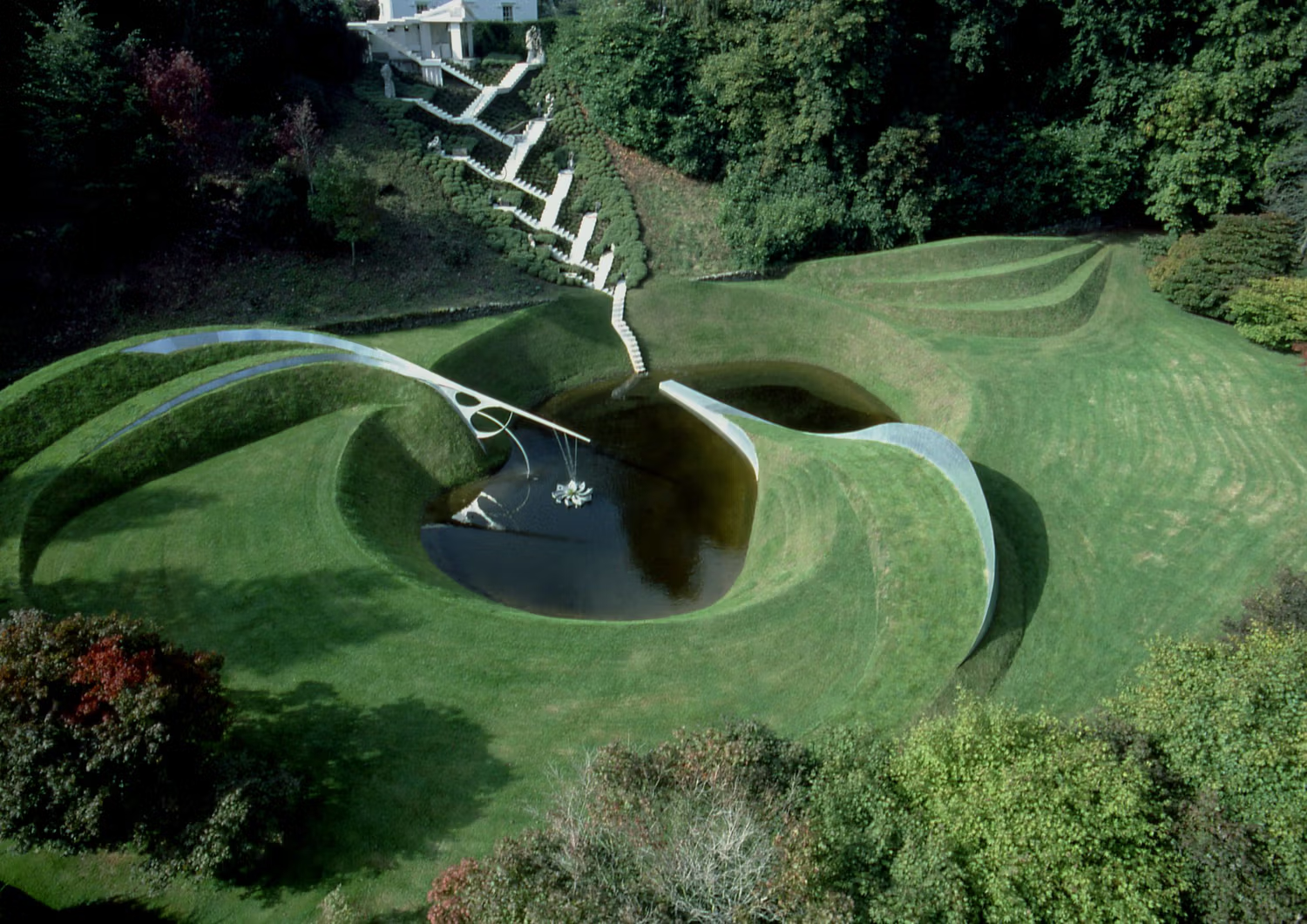
The Universe Cascade and Pond: Completed in 1996, the ‘Universe Cascade’ is a multi-branched, multi-levelled staircase of white concrete, located on the steep incline to the immediate rear of Portrack House. A narrow channel of water running down the branching steps counters a 13-billion-year timeline narrative running up, with important cosmic events or ‘jumps’ outlining the history of the universe, sculptured into 25 individual platforms using a variety of materials including volcanic rock and river stones. At the bottom of the cascade, the steps disappear into a dark pond representing a point of origin for the universe. Shaped turf-mounds with metal insets and water fountains surrounding the pool are inspired by the shapes of theoretical universes, and the impact of gravitational and other forces upon them.
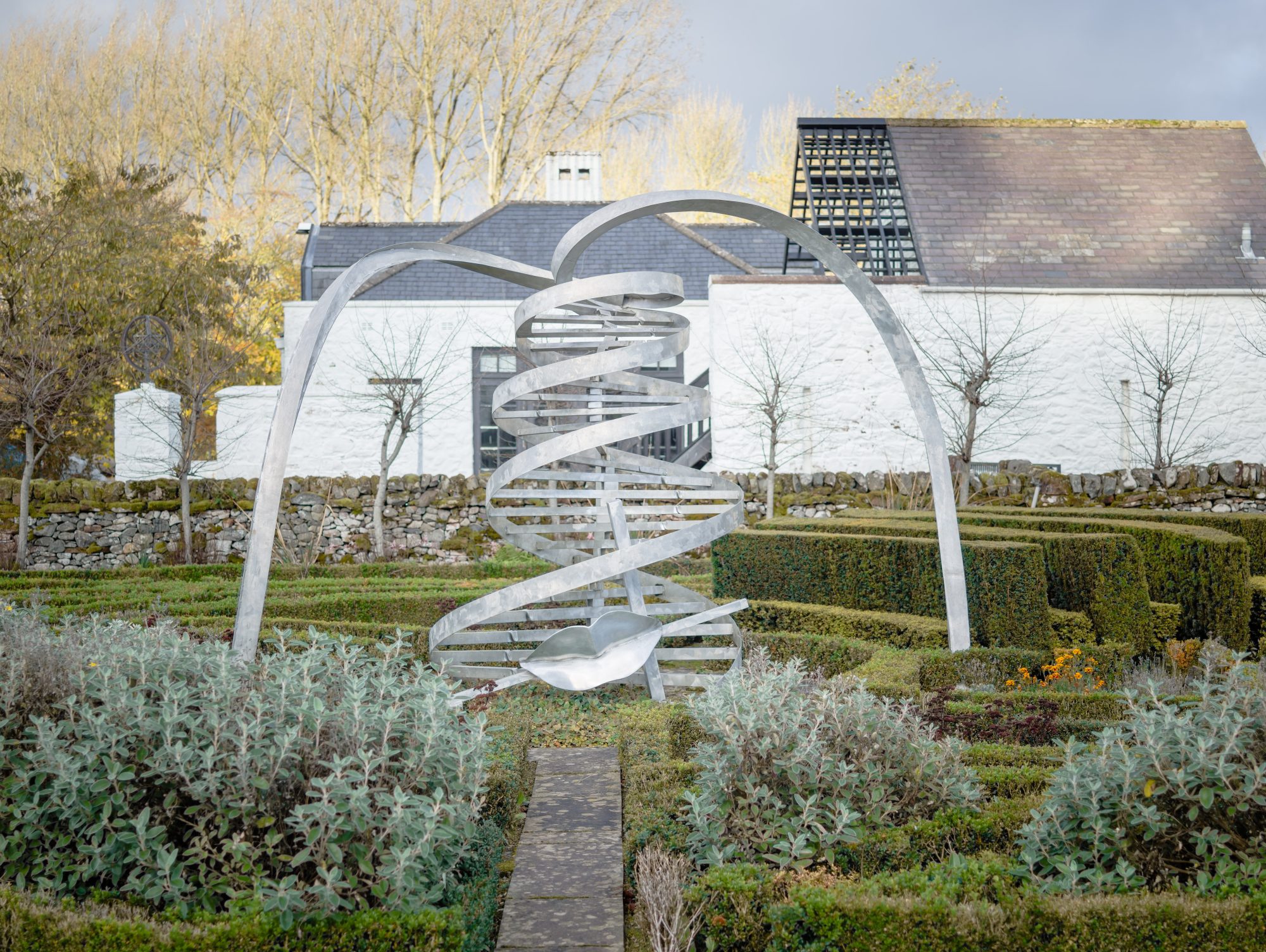
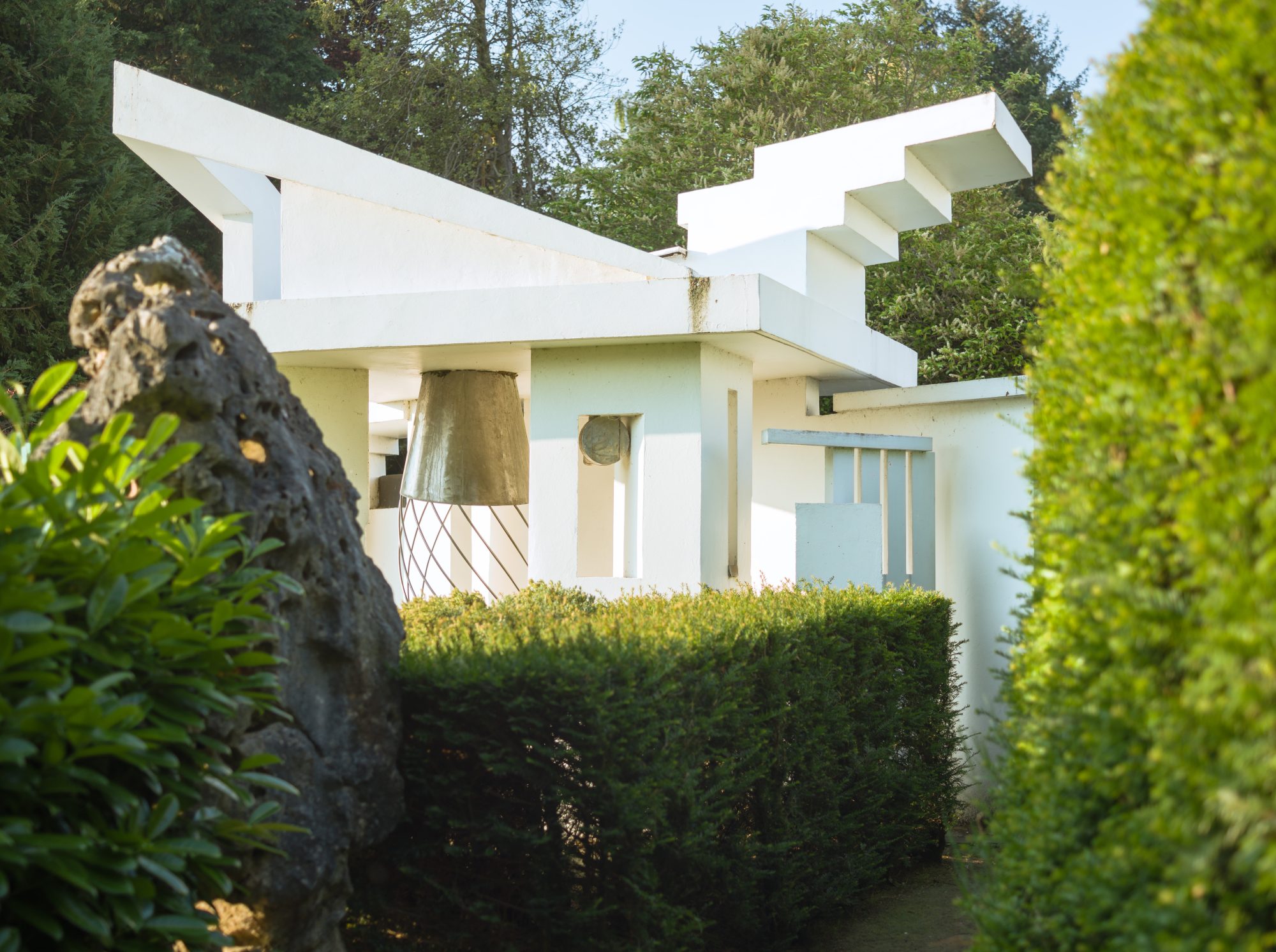
DNA / Six Senses Garden: The DNA or Six Senses Garden is a rectangular ‘kitchen garden’ space to the northeast of Portrack House, surrounded by undulating walls and consisting of six rectangular ‘cells’, divided by box hedging and pathways. Each cell contains a sculpture and planting relating to one of the five human physical senses and the double-helix structure that carries our genetic code. Planting is specific to each sense, with varieties chosen for their scent, taste, feel, appearance, or sound when blown by the wind. The sixth cell relates to the ‘sixth sense’ of intuition. Shaped metal gates, patterned pathways, benches, and inscribed words and aphorisms are all part of this densely encoded area of the garden. A large glasshouse to the immediate north has die-cast metal roof ridges that take the form of mathematical equations relating to key scientific laws of nature.
Comet Bridge and associated planting: The Comet Bridge links the central wooded area (Crow Wood) with a raised pasture or meadow to the east. It takes the shape of an elliptical comet or asteroid in flight. The bridge walkway is made of steel I-beams with punched circular holes, and the railings are aluminium fencing. On the woodland side is an oval boulder with colourful tree species planted around it including red maple, yellow-barked ash, silver-leafed white-beam and copper beech.
Quark Walk: Located on a path beside a water course, on the north-eastern boundary of the garden site, this installation features eight red-painted tree trunks representing the pattern created by the mixing of different types of quark particles. The mesh-like fabric of an undulating fence running through the trunks refers to the interference caused by light wave particles, splaying out as metal fronds over the water course.
The Garden of Scottish Worthies / Garden of Rails / The Bloodline: The Garden of Scottish Worthies (2002–2003) was developed during upgrading works to the active railway line and bridge over the river Nith. The replacement bridge is known as the zig-zag bridge. It stands alongside ‘the bridge to nowhere’ – a cantilevered reworking of remnants of the 1845 bridge. This infrastructure, designed by Charles Jencks in conjunction with Scott Wilson and Carillion, won the Saltire Award for Engineering Excellence in 2004.
The installation considers the impact of rail travel on social and industrial progress, equating it with the Scottish Enlightenment and the impact Scotland has had on the invention of the modern world. Seventeen turfed mounds line the rail track on the eastern approach to the bridge. These are surmounted by pierced metal signs commemorating seventeen influential ‘worthies’, mainly from 18th and 19th century Scottish history. Running parallel to the turfed mounds, the ‘Bloodline’ displayed the names of 40 significant people and events, from Agricola in 84AD to the construction of the Scottish Parliament in 1999 through the medium of aluminium banners hanging from a row of poplar trees.
Fishenge: This work beside the River Nith is located around 450 metres northeast of the zig-zag bridge. Its planform consists of two mirrored triangles of boulders, repurposed from nearby breakwaters or ‘croys’ that were intended, but failed, to act as resting pools for salmon travelling upstream. The two triangles are bisected by an avenue of boulders aligned on a northwest axis toward the sunrise over the distant hills. There are also angled turf mounds designed to offset the shapes created by the boulders. This installation prefigures Jencks’ interest in prehistoric landforms and standing stones, explored further at Crawick Multiverse.
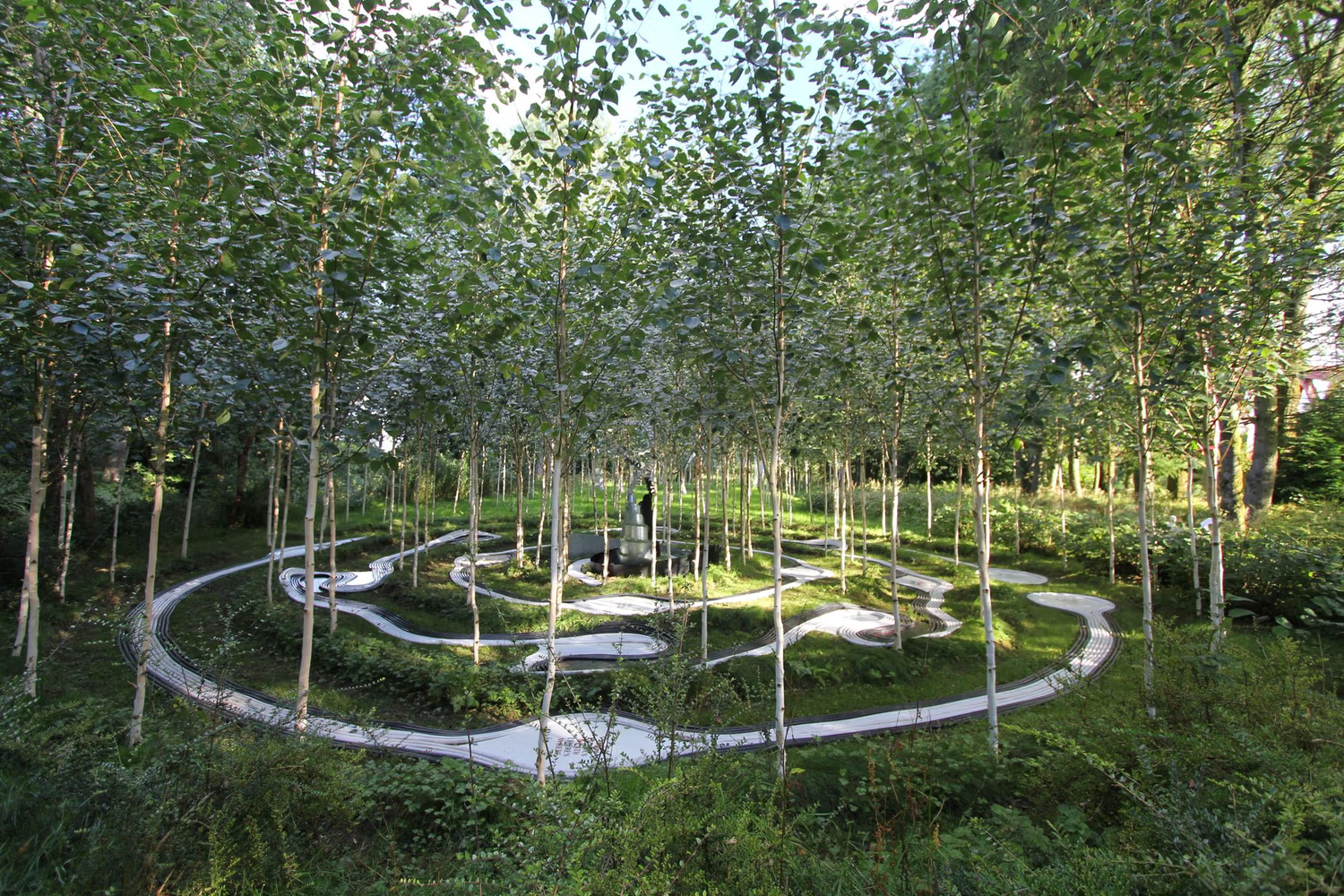
Other installations within the garden include the Garden of Time, the Willow Twist and Birchbone Garden, the Fractal Terrace, the Wave Fence and Gate, the Land and Water Dragon, the Devil’s Teeth, the Witches Brooms and Cauldron, and the Red Rust Exaptation Garden.

Become a C20 member today and help save our modern design heritage.