This website uses cookies
This website uses cookies to enable it to function properly and to analyse how the website is used. Please click 'Close' to accept and continue using the website.


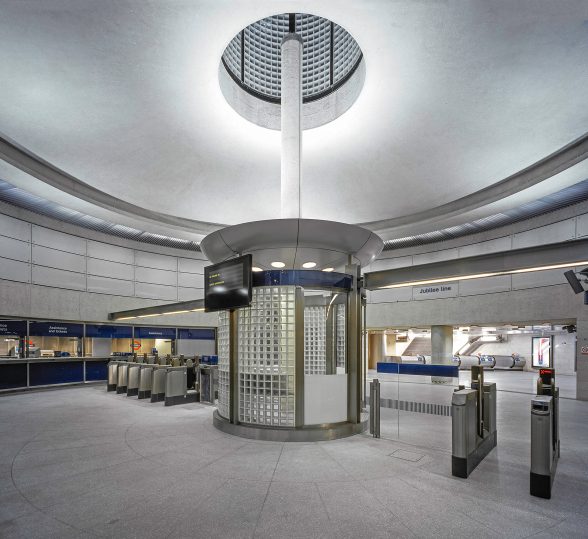
Image © Peter Durant
We’re thrilled to announce that Southwark Tube Station has finally been Grade II listed, nine years after C20 Society first submitted a listing application and a quarter of a century after opening to the public. Designed by architects MacCormac Jamieson Prichard and built 1994-1999, it was one of six new stations on the Jubilee Line Extension, one of the finest British architectural and engineering achievements of the past century.
The joyful experience of travelling from street to platform is a carefully choreographed delight. From the drum shaped entrance that recalls Charles Holden’s classic 1930s Arnos Grove tube station, to the subterranean skylit hall with artist Alexander Beleschenko’s dramatic geometric blue glass wall, this is transport infrastructure elevated to the sublime.
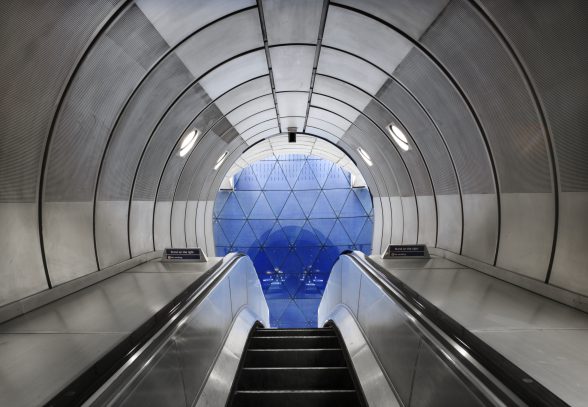
Image © Historic England
Architectural Sensation
The new stations on the Jubilee Line extension were hailed in 1999 as the biggest architectural sensation of their kind since the Moscow Underground. Commissioned by Roland Paoletti soon after he completed the impressive new Metro in Hong Kong, he chose a group of talented architects both established and at the beginning of their careers to lead the design work. It has been described as ‘one of the best examples of public sector patronage of our time’ and is now recognised as being the finest late twentieth century infrastructure development of its kind in Europe.
Southwark was designed by the late Sir Richard MacCormac, of architects MacCormac Jamieson Pritchard (MJP) and built between 1994-99. The genius of the design is most evident below ground. The architects’ stated objective for the station was to ‘create a kind of topographical architecture—a subterranean landscape consisting of alternating experiences of confinement and spatial expansion amplified by contrasting experiences of natural and artificial light.’ In this MJP succeeded sublimely. Southwark is redolent with historic architectural references in its design detail, and contains a large piece of geometric blue-glass art work, a collaboration of the architects with the artist Alexander Beleschenko and structural engineers YRM/Anthony Hunt, combining art, architecture, engineering, computer-aided design and manufacturing technology to stunning effect. The station building went on to win several win awards, including from the Royal Institute of British Architects and the Royal Fine Art Commission Trust.
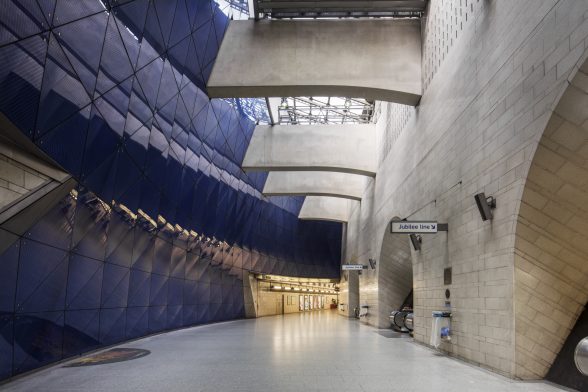
Image © Historic England
A decade long heritage battle
The Society first submitted a listing application for Southwark Station in January 2017, in response to proposals for a new over-station development that would have necessitated demolition of the station’s signature ticket hall. Our campaign was backed by SAVE Britain’s Heritage, gained international support from ICOMOS and widespread media coverage. Being under 30 years old at the time a designation of Grade I or Grade II* would have been required, and while Historic England’s assessment report described the station in its entirety as ‘exceptional’, it ultimately opted not to recommend for listing. C20 challenged the decision with the help of expert advice from Richard Harwood QC, but the matter had never been resolved by DCMS.
Revised proposals by AHMM for a 17 storey, 200,000 sqft office and retail development above Southwark Station subsequently gained planning consent in 2021. These were welcomed by the Society, as they retained the ticket-hall and involved no element of station demolition. In July 2024 it was announced the scheme was to be redesigned yet again, this time as student accommodation, casting doubt once more on the future of the station complex.
With Southwark Station turning 30 years old in February 2024 (construction work began in February 1994), DCMS made a timely recommendation that the station be re-assessed by Historic England. C20 Society strongly restated our belief that it is of exceptional architectural, historic and engineering interest, and now clearly meets all the criteria for national listing. Its Grade II designation was finally confirmed on 10 November 2025.
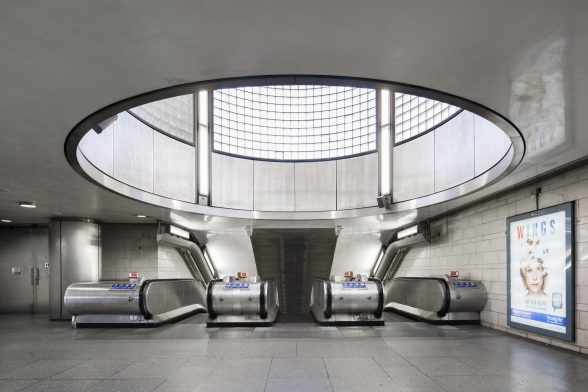
Image © Historic England
C20 Director, Catherine Croft, commented:
“We’re absolutely thrilled with the news that Southwark Underground Station has been listed, just a quarter of a century after it first opened to the public. The Jubilee Line Extension is one of the finest British architectural and engineering achievements of the past century, with Southwark Station is just one of many jewels in the crown.
The joyful experience of travelling from street to platform is a carefully choreographed delight. From the drum shaped entrance that recalls Charles Holden’s classic 1930s Arnos Grove tube station, to the subterranean skylit hall with artist Alexander Beleschenko’s dramatic geometric blue glass wall, this is transport infrastructure elevated to the sublime.”
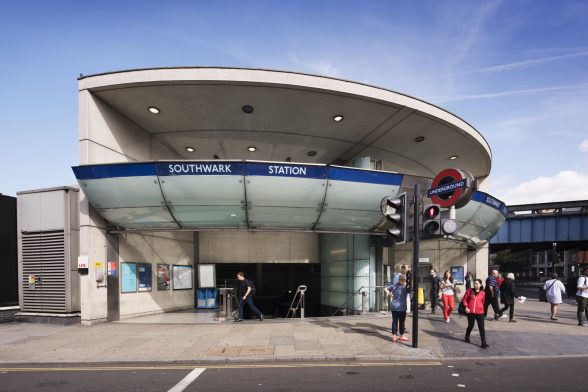
Image © Historic England
Heritage of the Jubilee Line Extension
In the Society’s view, and that of our expert advisors on transport and infrastructure, there are four further stations on the Jubilee Line Extension that are clearly deserving of national listing in their entirety, and two additional stations with with partial or more extensive significance. We hope and expect that these will also be added to the National Register in due course.
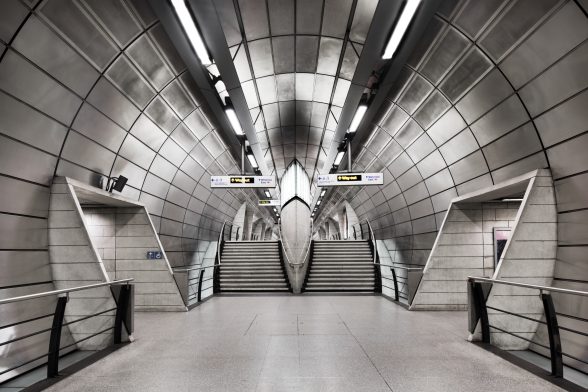
Image © Historic England
Campaigning for the London Underground
The London Underground has long been feted for its design: the patronage of Frank Pick; the posters and Edward Johnston typeface, and Charles Holden’s interwar stations. But its 280 stations haven’t always been as protected as they could be. Prompted by the under-listing of stations, and unauthorised works being undertaken even in those that were listed, in 1987 the C20 Society (then known as the Thirties Society) issued a report End Of The Line? The Future of London’s Underground, which attracted much press attention and led to a change of personnel and attitude, especially following the King’s Cross Fire later that year.
Subsequently, C20 discovered that signage removed from stations, including from listed buildings without consent, was being put up for sale at auction, and after a refusal by LT to withdraw them, forced a legal ban on these items amid much publicity. In 1997, with just 59 of 280 stations listed, a further C20 report recommended ‘that a total of 42 currently un-listed stations are considered for listing by virtue of their special historic and architectural interest’. The Society’s campaigning for the Underground also helped safeguard the much-loved Eduardo Palozzi murals at Tottenham Court Road, in 2015. While some of the artist’s work at the station was sadly lost in redevelopment works, the vast majority was preserved and conserved thanks to the Society’s crucial intervention.
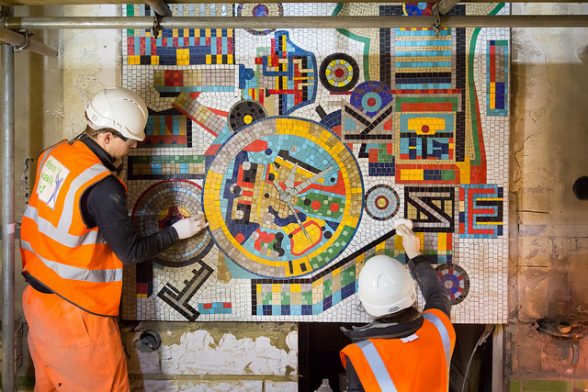
Image © Transport for London
Become a C20 member today and help save our modern design heritage.