This website uses cookies
This website uses cookies to enable it to function properly and to analyse how the website is used. Please click 'Close' to accept and continue using the website.


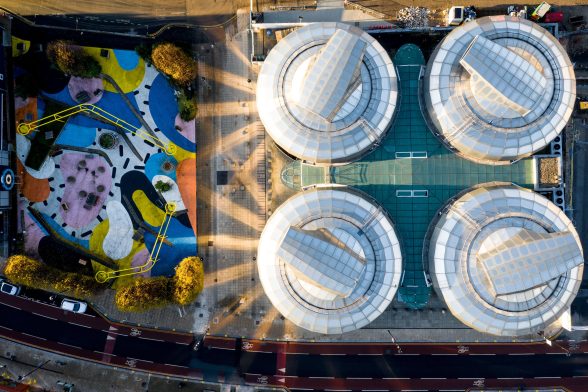
Image © Clare Jackson
The former National Centre for Popular Music in Sheffield has been added to the South Yorkshire Local Heritage List, putting it in the ‘waiting room’ for future national listing, as the campaign to safeguard the distinctive ‘kettles’ building from potential redevelopment gathers momentum. Designed by architects Branson Coates and opened in 1999, the Pop Centre was a failure as a cultural venture and closed in 2000, yet the building itself has had a highly successful second chapter over the past two decades; repurposed as ‘The HUBS’ student union for Sheffield Hallam University
The building is the flagship case in C20’s Risk List 2025-26, with the threat faced by many of Britain’s Millennium projects a central theme of the campaign. The local listing designation follows an application by Sheffield Civic Trust amid concerns that the University were exploring options to demolish the building, as part of the wider campus masterplan.
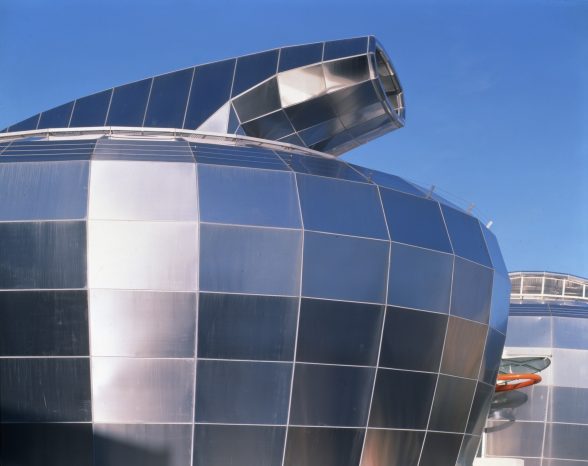
Image © Graham Gaunt / Nigel Coates Studio
The ‘Bilbao effect’
Chasing the ‘Bilbao effect’ of cultural led urban regeneration, Sheffield’s shimmering Pop Centre was consciously designed as flamboyant architectural icon, yet became emblematic of the mixed fortunes of Britain’s many Millennial era projects. It closed in June 2000, just 15 months after opening, to mocking headlines such as ‘Top of the flops’ and ‘Rock Horror Show’. However, its afterlife proved far more successful; acquired by Sheffield Hallam University in 2003, the building has served as a popular student union ever since. Yet in 2024, the University announced its intention to relocate the student union to another location in the city centre, with demolition of the former Pop Centre pointedly not ruled out.
Branson Coates’ design acknowledged the city’s heritage in steel production; the four drum galleries were clad in stainless steel panels, with their outline referencing industrial storage tanks and, more arcanely, pinball machines. Each drum incorporated a state-of-the-art low energy air handling system, with stale air being sucked upwards through the four rotating cowlings that topped the drums. On first approaching the building, a glazed cruciform link with a wide central stair drew visitors up to the gallery entrances on the first-floor level, where people would choose which drum to enter first and ‘effectively could write their own script’.

Image © Graham Gaunt / Nigel Coates Studio
‘Waiting room’ for national listing
Unlike national listing (determined by the DCMS on advice from Historic England), local listing is determined by the local planning authority (LPA). It is effectively the next rung down from national listing, below Grade II, and dates back to the abolition of the national Grade III listing category in 1983. C20 has long stressed the importance of securing local listing designations for buildings of our period, as an effective ‘waiting room’ status for future national listing.
The thresholds for listing at Grade I, II* or II are high, and the criteria for 20th century buildings are stricter than for older buildings. For buildings under 30 years old, individual listing cases are only progressed where a building is under severe threat of major alteration or demolition and would meet the criteria fir II* or higher. In such cases, local listing can provide a marker for a building that we are poised to put forward for national listing if such a threat arises.
This ‘waiting room’ message is key. For many late 20th and early 21st century buildings we know that new research and changing attitudes will in time lead to revaluation. They’re not yet considered old or rare enough to merit national listing – but they will some day soon, and in the meantime they need all the protection they can get to survive. A good case study being the former IBM building (Denys Lasdun 1979–83) on London’s South Bank; added to the Lambeth Local List in 2010, ten years later it achieved nationally listed status (Grade II) following an application by C20 Society, after plans for demolition were tabled.
Become a C20 member today and help save our modern design heritage.