This website uses cookies
This website uses cookies to enable it to function properly and to analyse how the website is used. Please click 'Close' to accept and continue using the website.


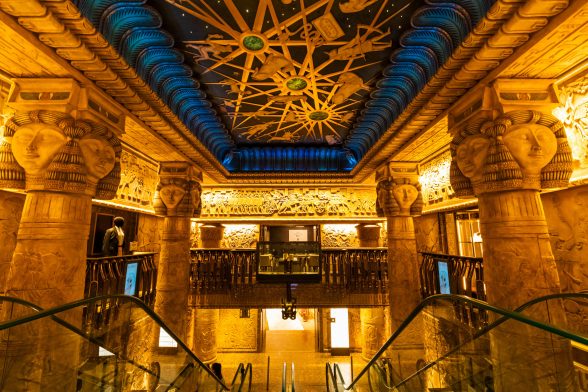
Image credit: Steve Vidler
William Mitchell’s ‘masterpiece’ Egyptian Escalator Hall (1997) at Harrods in Knightsbridge is under threat, after the department stores’ new Qatari owners applied for Listed Building Consent to rip out the Grade II* listed feature. C20 Society has written to the Royal Borough of Kensington and Chelsea, strongly objecting to the plans.
One of Britain’s greatest post-war artists, William Mitchell (1925-2020) has more listed works on the national register than any other artist (see full list below). The Egyptian commissions at Harrods were his last major project and he stated: ‘Without hesitation, or embarrassment, I feel I am able to call [it] my masterpiece.’ The list description for Harrods, updated in 2000 shortly after the hall was completed, explicitly refers to it as ‘the most significant of the modern concept interiors’.
Particularly controversial are the several carved Pharaonic figures, with a likeness to former Harrods owner Mohamed al Fayed, who is accused of raping and sexually assaulting dozens of women. The LBC application states ‘the Egyptian Escalator explicitly celebrates Mr al Fayed, including sixteen huge sculptures of his face’, adding that they represent ‘a visual reminder of his misdeeds’. The new plans, led by architects Make, involves the complete loss of the existing Mitchell-designed fabric and replacement with a bland and ahistorical scheme. The justification provided for the new work also includes creating ‘a more inclusive design’ for accessibility and that the ‘highly stimulating interiors’ of the escalator hall create overstimulation for neurodivergent individuals, leading to discomfort and anxiety.
The Society is in agreement that the offending figures with a representation of Mr al Fayed should be removed, yet this should not necessitate the demolition of the entire escalator hall, a work of national artistic importance.
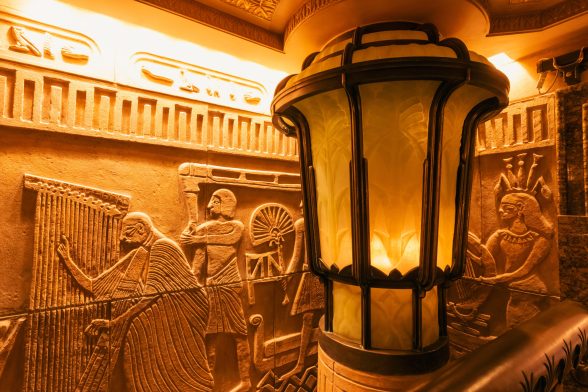
Image credit: Steve Vidler
‘Stairway to Heaven’
The Harrods project was planned as a permanent, major refurbishment of three spaces: the escalator hall, a lower hall in the basement, and an Edwardian room on the ground floor. This was rebranded as the Egyptian Hall and chosen because it had already been stripped of its traditional friezes and panels in the 1930s and painted white, so barely any original decorative features had survived. The latter two were remodelled to an Edwardian decorative scheme in 2022 and 2023 respectively, with all the works created by Mitchell lost. The most spectacular and significant of the three spaces, the surviving Egyptian Escalator Hall, was created within a five storey circulation area occupied by a bank of six elevators, installed 1927-8.
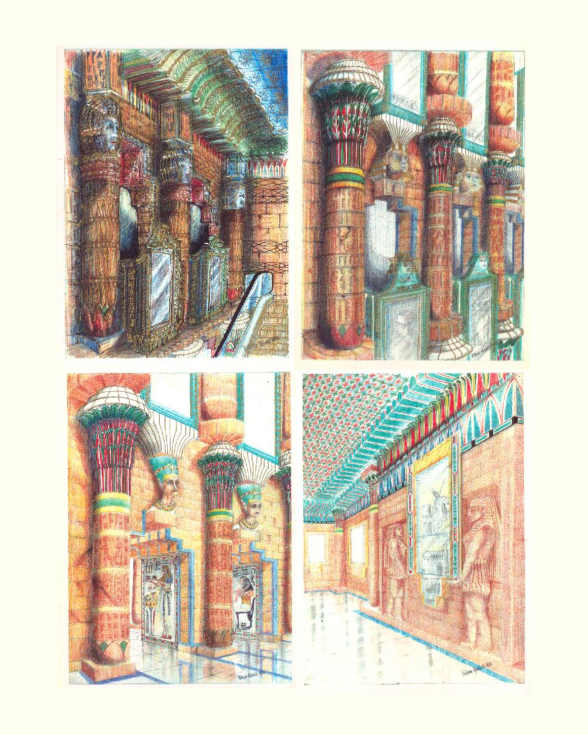
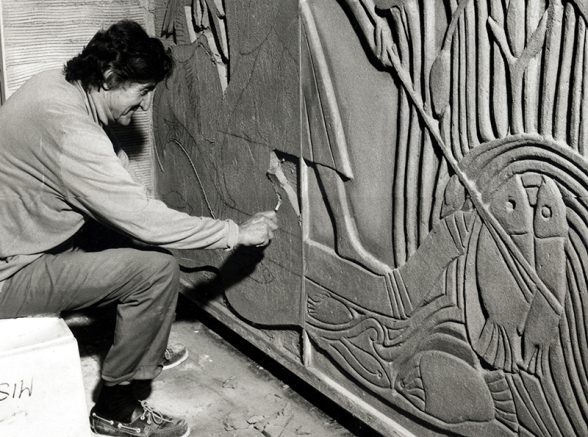
Linking these floors allowed Mitchell to incorporate 25-foot-high columns clad in reproduction hieroglyphs around the escalator, with illuminated papyrus-like column capitals, in keeping with the colossal scale of ancient Egyptian buildings. The scheme is characterised by 300 moulded panels, painting and bas-reliefs, hand-carved by Mitchell and representing scenes of everyday Egyptian life. The ceiling frieze is notable as the culmination of a unifying ‘Stairway to Heaven’ concept, with its interpretation of the ancient astrological wheel as taken from the Temple of Hathor’s wall relief panel held in the British Museum
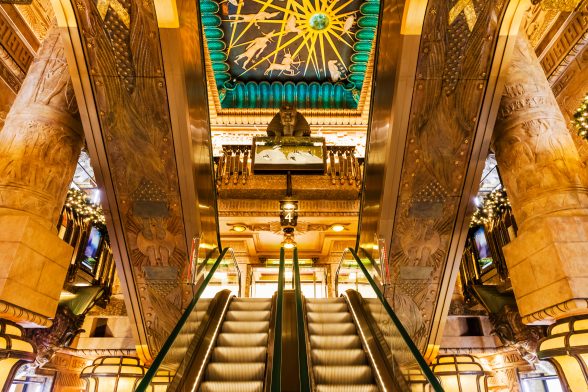
Image credit: Steve Vidler
Postmodern Egyptomania
Begun at the age of 73, the project was Mitchell’s last major commission, successfully combining his earlier abstract relief work with his mature figurative sculpture. The project was rooted in thorough research and authenticity, with Mitchell consulting the curator of Egyptian antiquities at the British Museum to ensure he stayed true to the 18th Dynasty style, using plaster, granite, bronze and earth pigments. With the department store already a listed building, the project provided Mitchell with what he described as his ‘ultimate challenge.’ Seeking permission from English Heritage (now Historic England) to make necessary changes, these were granted with the proviso that plans were strictly adhered to, with a warning for the ‘Egyptomania’ not to get out of hand.
Described as the most ambitious project in the store’s colourful 147 year history’ by Harrod’s in a 1997 press release. It remains as a unique example of post-modernist Egyptomania sculpture and relief in a retail environment and sits within the wider context of Ian Pollard’s Warwick Road Homebase (demolished in 2014) and John Outram’s Grade II*-listed Sphinx Hill, which became the country’s youngest listed building last year.
With special thanks to Dr Dawn Pereira – architectural historian, artist, educator and author of a forthcoming monograph on Mitchell – for her expertise and invaluable contribution to this case.
William Mitchell Archive
William Mitchell
William ‘Bill’ Mitchell (1925-2020) was one of the most important sculptors active in England in the post-war period. The Society has long been interested in Mitchell and many of his works have been saved thanks to our ongoing Murals Campaign, launched in 2009. Wider appreciation for Mitchell’s work continues to grow and 16 of his artworks are now listed on the national register. While a recent bid to list the inlaid resin mural at Brooklands Park Estate in Greenwich was unsuccessful, funding was secured from the Heritage of London Trust to relocate and restore the artwork. A further pair of murals at Foxborough Gardens in Lewisham are undergoing conservation thanks to support from HOLT and the Pilgrim Trust.
National listed works by William Mitchell:
Become a C20 member today and help save our modern design heritage.