This website uses cookies
This website uses cookies to enable it to function properly and to analyse how the website is used. Please click 'Close' to accept and continue using the website.


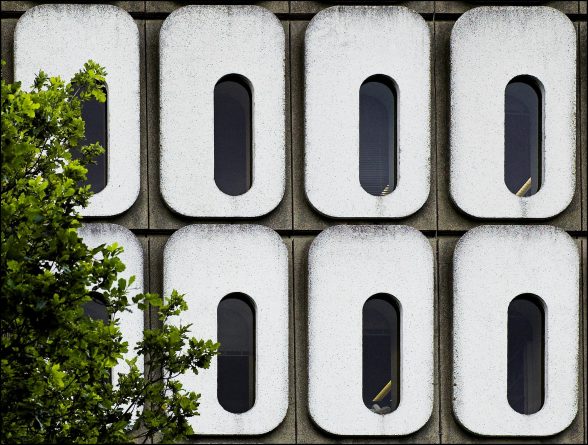
Image © Eggy Boil (Flickr)
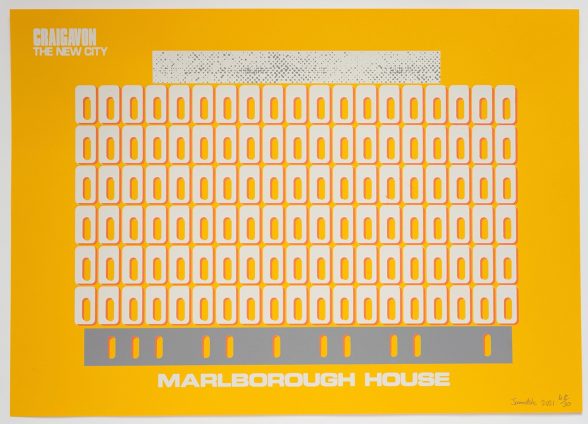
Marlborough House (1973-77) in Craigavon, Northern Ireland, has been B1 listed following a proposal by the NI Department for Communities and the support of the Ulster Architectural Heritage Society. Known locally as the ‘Lego building’, the often controversial office block is one of the most significant late 20th century buildings in Ulster and a remnant of the experimental Craigavon ‘New City’ development, modelled on Cumbernauld in Scotland.
Heritage listing was first raised in October 2024 as it was announced that the current occupiers, the NI Department of Finance, would vacate the building in 2026 and the future of the site came under discussion. The proposal led to a backlash from Craigavon Councilors and some Stormont Minsters, strongly opposed to granting protected status. However, after a public consultation period, the designation was duly confirmed in October 2025.
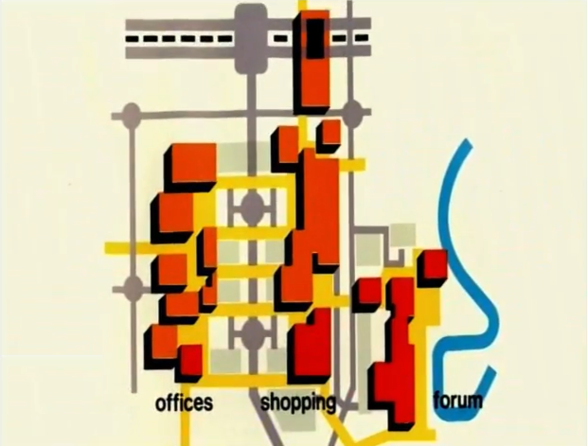
‘First beat for heart of New City’
Designed by Craigavon Development Corporation (CDC) architects, led by Sandy Bannerman and Donal Crawley, construction of Marlborough House started in late November 1973. The freestanding Modernist seven-storey office block was conceived as part of the first – and as it turned out, only – coordinated phase of the town centre of the ‘New City’ of Craigavon, to date Northern Ireland’s sole New Town development. The building is closely bound up with the story of Craigavon, whose inception and evolution was a major event in the history of the country, and which was viewed at the time as the stimulus for the modernisation not only of urban planning but for NI society in general.
It remains the only building of that initial town centre phase to have survived in anything resembling its original form and as such is an expressive representation of the whole Craigavon project, and a unique local structure. It is also one of Northern Ireland’s most unusual and distinctive Modernist 1970s designs, being a cuboid structure with a façade almost entirely ornamented by a space-age grid of concrete panels which are angled slightly giving the block the impression of being wedge shaped when viewed up close. Documentary evidence shows that Marlborough House was promoted as state-of-the-art office space, with contemporary sources repeatedly alluding to it being ‘one of the most advanced blocks in Britain’, an ‘ultramodern office block’ a ‘city centre showpiece’, with ‘accommodation of the highest standard’ that far outshined ‘anything on offer in the rest of Ulster’ with particular attention made to the ‘futuristic heating system’ utilising ‘thermal balance rays and which is completely automatic’ and the ‘use of natural light to cut down on costs’.
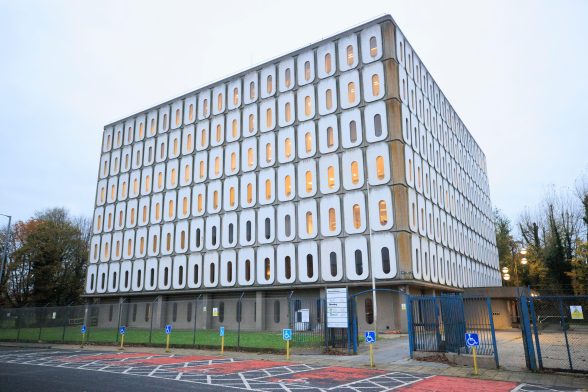
Image © PA Images
‘The house that nobody wants’
The cuboid office block was designed as one of the initial components of the core – or town centre – of the new city of Craigavon, located between Lurgan and Portadown, and was constructed in 1973-77. In addition to serving as administration space for the new Craigavon Borough Council, it was hoped the building would both attract and provide accommodation for private businesses wishing to establish themselves in the area. However no private tenants were forthcoming and in January 1976 the Council decided against taking up the offer of a floor and a half, choosing instead to push for a dedicated Civic Centre, leading to it being featured in a newspaper article as ‘the house that nobody wants’ and dubbed by some locals as ‘the white elephant. With little interest being shown from commercial occupiers, the Government decided in May 1977 to use the premises for Housing Executive and Civil Service personnel. The block finally received its first occupants – the staff of HM Inspector of Taxes, Craigavon – in December 1978. They were joined by the Area Officers of the Housing Executive in March 1980, with the local DoE Planning Office taking up the remaining three floors by the end of that year.
Recently the building has housed the Department of Finance offices, but they are intending to vacate later in 2026, leaving future occupancy and ownership uncertain.
John Anderson of the Ulster Architectural Heritage Society said the building is significant and could have a multitude of future uses: “Whether you like it or not is a matter of taste, but it is a very distinctive building…It’s of national and possibly even international importance. In its design it’s very much of its time, and of the ‘new town’ movement that was prevalent right across the UK, and Europe for that matter. It’s very much a building that could be repurposed.”
Heritage Listing in Northern Ireland
Statutory listing of buildings began in Northern Ireland in 1974 and the ‘First Survey’ of listed buildings took over 20 years to complete. The Government Department for Communities maintains ‘The List’ of buildings of special architectural or historic interest, and currently contains more than 9,100 entries. Buildings included in the statutory list are divided into different grades: A, B+, B, B1 and B2. However, the statutory controls apply equally to all listed buildings, irrespective of grade.
Grade B1, the designation given to Marlborough House, is defined by the NI Historic Environment Division as ‘a good example of a particular period or style. A degree of alteration or imperfection of design may be acceptable. Generally B1 is chosen for buildings that qualify for listing by virtue of a relatively wide selection of attributes.’
Become a C20 member today and help save our modern design heritage.