This website uses cookies
This website uses cookies to enable it to function properly and to analyse how the website is used. Please click 'Close' to accept and continue using the website.


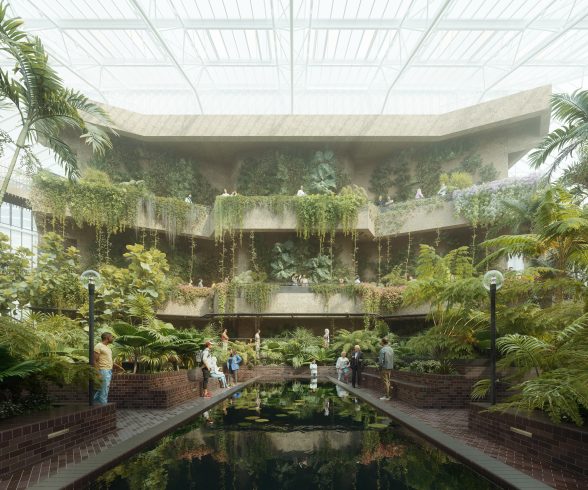
Image credit: Kin Creatives for Allies and Morrison and Asif Khan Studio
Planning permission has just been granted for the £231 million Barbican Renewal Programme, following an extensive pre-app consultation and the support of C20 Society. The decision by the City of London Corporation secures the future of Europe’s largest multi-arts centre and safeguards one of the world’s most significant Brutalist buildings, ahead of its 50th birthday in 2032.
The approved plans have been designed with access and sustainability as the focus, and will deliver the most significant accessibility improvements in the Barbican’s history. Alongside the installation of a new lift in the ‘Eco-Brutalist’ Conservatory – providing step-free access to the fly tower for the first time – a second lift in the main foyer will significantly enhance accessibility to the Concert Hall, Theatre and surrounding spaces. Led by Allies and Morrison, with Asif Khan, engineers Buro Happold, and landscape designers Harris Bugg Studio, the sensitive and conservation-led scheme will also reinstate and replicate key original design features, bringing the Centre closer to the original vision of architects Chamberlin, Powell and Bon.
The Barbican has been described as the greatest work of British planning and architecture of the 20th century, in the great tradition of bloody-minded English Baroque from Vanburgh and Hawksmoor via Nash. The Arts Centre was largely designed in its present form in 1968, and was built 1971-82. Peter Chamberlin and Christoph Bon (of Chamberlin, Powell and Bon) were architects in charge, with John Honer and Gordon Ruwald as project architects. Lying within the Barbican & Golden Lane Conservation Area, the Estate was Grade II listed in 2001 and its landscape Grade II* registered in 2003.
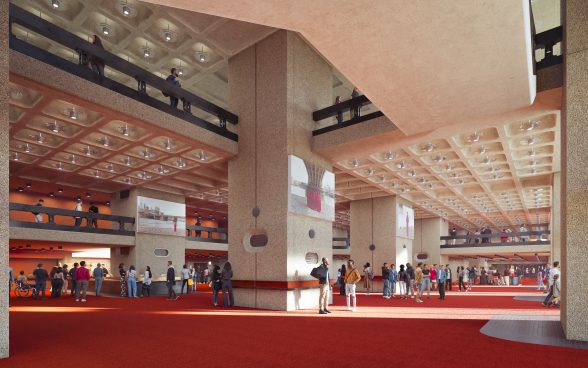
Image credit: Kin Creatives for Allies and Morrison and Asif Khan Studio
Conservatory and Foyers
Within the much‑loved Conservatory the renewal will address long‑standing maintenance and accessibility challenges while introducing a climate-controlled habitat that ensures plant health and longevity. Currently only 30% accessible and has major issues with fabric condition, including serious leaks into the theatre below that need addressing. A new lift and stair will offer public access to the Conservatory’s raised balconies, opening up spectacular new views across the space, enabling regular free public access to experience an immersive, lush environment where temperate, tropical and arid species will flourish.
The generous Foyers with their bold form and rich finishes have been subject to piecemeal alterations over the years, with elements of the original fabric now covered up or in need of repair. Sections of covered up or lost paved floor will be reinstated and the concrete cleaned. The shop, which was inserted in the early 2000s, will be removed from its current location and relocated, helping to re-establish a key view within the interior. The original Chamberlin, Powell & Bon coffer lighting in the foyers will also be reinstated.
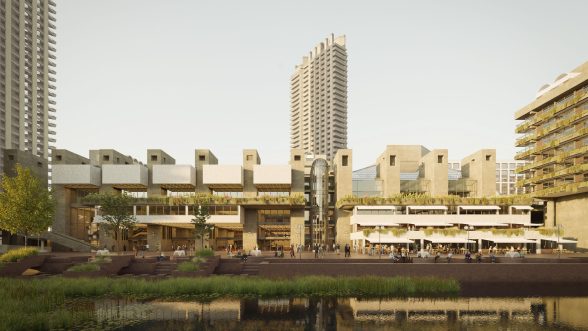
Image credit: Kin Creatives for Allies and Morrison and Asif Khan Studio
Lakeside Terrace
The Lakeside Terrace is one of London’s great open spaces. Here the scheme re-emphasises the central three entrances off the lakeside, which have lost the prominence they originally had. The original style spherical glass fittings will be restored in locations where they have been removed, and original style coffer lights reinstated on the underside of entrance canopies. Other elements which are either at the end of their design life or in need of maintenance, such as the brick paviours and the fountains, will be restored and re-waterproofed. The Lakeside edges will be replanted and relandscaped with dedicated irrigation and climate resilient, low maintenance, plants. These will have a visual relationship with the replanted terraces across the upper levels of the lakeside facade.
The Barbican Renewal Scheme has been developed with a sustainable, retrofit approach which protects the heritage of the Grade II-listed building while significantly reducing long-term environmental impact. Materials such as Conservatory glass and pavers will be reused, reflecting a commitment to sustainable conservation where possible.
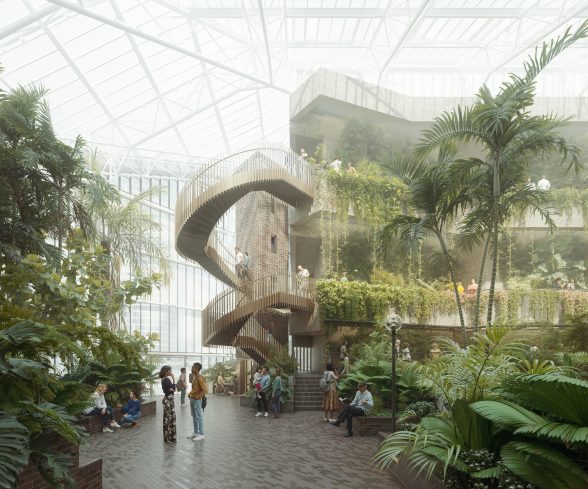
Image credit: Kin Creatives for Allies and Morrison and Asif Khan Studio
Catherine Croft, Twentieth Century Society Director, said:
“The Barbican Centre is an incredibly important part of this listed, post-war mega-structure and we’re delighted it is receiving significant investment ahead of its 50th birthday. C20 Society has been closely involved in the development of the Renewal scheme and welcomes the sensitive, heritage-led approach. It balances the need to widen access to the arts centre with carefully reinstating and replicating original design features from 1982.”
“Public fondness for once under-appreciated Brutalist architecture continues to grow, with the Barbican’s thrilling juxtaposition of exquisitely detailed concrete, arcadian greenery and animated water a delight for residents and visitors alike. The Lakeside Terrace and Conservatory in particular, have become some of London’s most relaxing and inspiring public spaces, which the Renewal programme will refresh and enhance.”
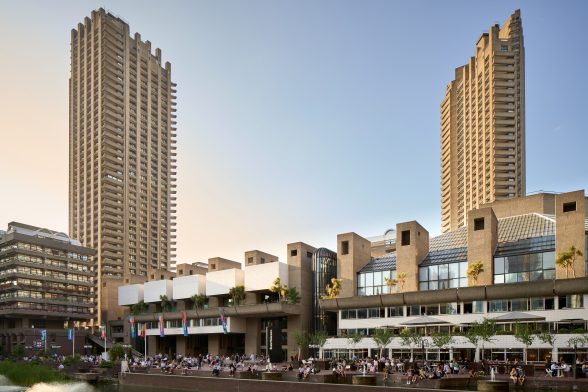
Image credit: Dion Barrett
Become a C20 member today and help save our modern design heritage.