This website uses cookies
This website uses cookies to enable it to function properly and to analyse how the website is used. Please click 'Close' to accept and continue using the website.


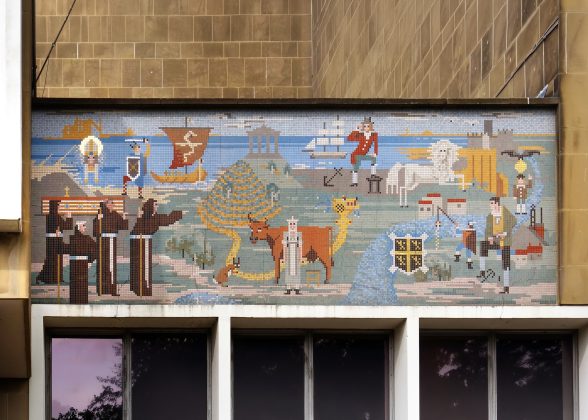
Image credit: Des Blenkinsopp (CC BY-SA 2.0)
A ‘pixel mosaic’ mural depicting more than a thousand years of the history of County Durham is under threat of demolition, with C20 Society joining Professor Bennett Zon of Durham University, Durham City Trust, the Tiles and Architectural Ceramics Association (TACS), City of Durham Parish Council and Jackfield Conservation Studio in campaigning to save and relocate the artwork.
The large ceramic tile mural was designed by the Durham County Council architects, G. R. Clayton and G. W. Gelson in the early 1960s, and affixed above the entrance of the now vacant County Hall building. It depicts the story of Durham, from the Venerable Bede and the Viking raid on Lindisfarne (793 CE), to the founding of the cathedral (1093), the Penshaw Monument (1844), Captain James Cook (1728-79), the county’s collieries and the steel works at Redcar.
Conservation experts at The Tiles and Architectural Ceramics Society believe it to be the one of the earliest examples in the country of a proto-digital pixelated mosaic design, where each pixilation is made up of a single mosaic tesserae – predating widespread digital imagery and early computer games by 20 years or more.
Other artworks have already been successfully relocated from the site. The Building of Durham Cathedral painting by Thomas Pattison (1894-1983) has been moved to Ushaw Historic House, and the 9m long Durham Miners’ Gala Mural – the largest work by celebrated mining artist Norman Cornish (1919-2014) – which was commissioned specifically for the County Hall in 1962 and moved to Bishop Auckland Town Hall in 2020.
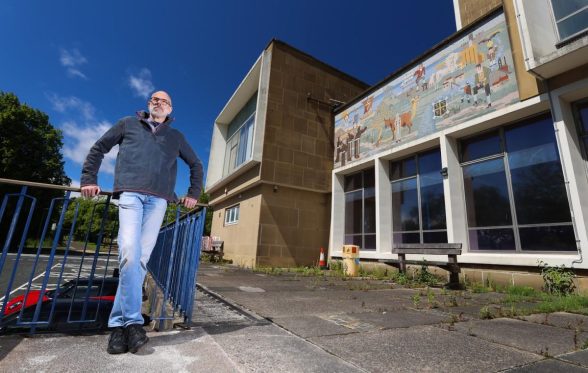
Image credit: Chris Booth, Northern Echo
Council Music Chairs
In 2019 it was announced that Durham County Council would leave their home of more than 60 years, with staff leaving County Hall in August 2026 and demolition of the building expected to start in March 2027.
A smaller, new-build council facility at Freeman’s Place in the centre of Durham was completed in 2022, at a cost of £50 million. After the Labour council leadership that green-lit the new building was replaced by a Conservative-led coalition in the 2021 local elections, a decision was made to sell the new building to Durham University for £84 million, to become a new home for the university’s business school.
In 2023 plans changed again, when the proposal to build a new civic centre on the current site at Akeley Heads was scrapped, the council opting instead to acquire the nearby Rivergreen office building (2006) and convert it to a new council HQ.
The news of impending demolition prompted C20 Society to submit a listing application for County Hall in June 2025, but Historic England declined to recommend it for statutory listing, their assessment concluding: ‘[the building] possesses design features more reminiscent of the early post-war period and is therefore old-fashioned and lacks innovation.’
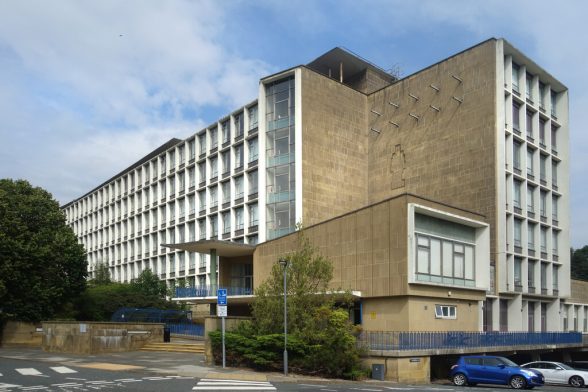
Image: Modern Mooch
Festival style civic architecture
Designed by County Architect GR Clayton between 1949 and 1956 and completed by his successor GW Gelson in 1963, County Hall is Durham’s largest civic building. It housed between 750 and 1,500 staff across multiple open-plan offices, with a council chamber, committee rooms, and the ceremonial Durham Room. Sitting within its own landscaped grounds at Akeley Heads, the complex was carefully sited away from the city centre to reduce any conflict with its historic surroundings.
It comprised of a six-storey T-shaped office block (originally planned to be twice as tall) with an attached two-storey staff block at the west end of the north range, and a council chamber attached to the rear of the south range; the latter connects to a restaurant via a covered walkway. The building exemplifies what has been termed the ‘Festival of Britain style’ or mid-century modern approach, also blending elements of 1930s Art Deco civic architectural tradition with continental modernism. It features high-quality design and craftsmanship throughout, with materials including marble and mosaic facings, extensive use of wood veneers, futurist-style light fittings, stained glass, and specially designed furniture.
County Hall was opened in 1963 by His Royal Highness The Prince Philip, Duke of Edinburgh. It was first assessed and rejected for listing in 2009, then again in 2025.
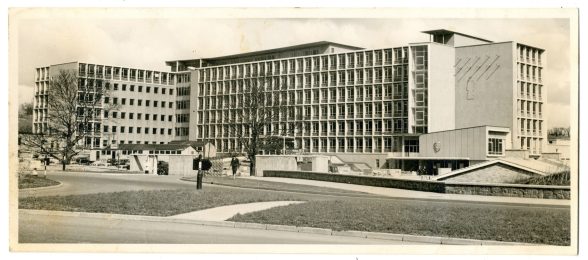
Image credit: Durham County Council Archives
Mural relocation
Sarah Glynn, Durham County Council’s strategic manager of culture, said in a statement:
“We appreciate the strength of feeling and sentiment for the mural at County Hall, and recognise that it holds some historical interest. However, a condition survey and technical assessment from specialists found that the mosaic has become cracked and damaged. Sadly, moving the mural without causing further damage would be almost impossible, and conventional conservation methods are not viable.”
“The only potential removal option would involve cutting the mural into multiple sections. This would carry significant risk, including further damage, visible repair lines where it has been reassembled, and potential health and safety concerns due to the likelihood of asbestos.”
In response, the Society has cited some of the many post-war public murals to have been succesfully removed, restored and relocated in recent years. These include the Dorothy Annan murals, now on display at the Barbican; Gülsün Erbil’s Equality-Harmony mural, removed from Broadwater Farm Estate in Tottenham and now being conserved; the William Mitchell mural in Hatfield, formerly at the Lee Valley Water Company Offices, and his mural at Brooklands Park Estate in Blackheath; and The Alchemist’s Elements mural by Hans Tisdall, at the University of Manchester.
Become a C20 member today and help save our modern design heritage.